Why do we take such risks to climb in Colorado's mountains? It is a question non-climbing friends inevitably ask me every time news circulates of another accident or death in the Colorado mountains. Why would I put my life in jeopardy just for the thrill of a summit? They say it is selfish to the ones I love back home to risk so much just for my own gratification. Some even say it is stupid. The answer is not always easy.
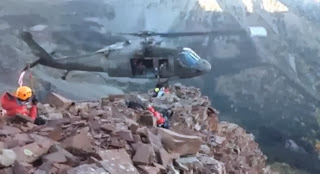 |
| Screenshot from a video showing a rescue on North Maroon in 2013 |
Life is full of risk. And without risk there is no reward. Climbing enhances my life, it is one of the things that helps remind me of why life is worth living in the first place. I don't climb with a death wish, and I always have full confidence I will return to the trailhead alive. I strive to make the best decisions and minimize the dangers of any particular climb. And now, as I have grown a bit older and have more responsibility I have found myself slightly less willing to accept those risks.
Still, however, the world isn't safe. Climbing and mountaineering is full of hazards, both objective and subjective. This can go wrong in an instant. A rock can break, the hills can slide, and, yes, I can make a terribly bad decision. But the same is true while driving on the highway: an errant driver can steer my direction, a patch of unseen ice can appear seemingly from nowhere, or I can take my eyes off the road for a fateful second to fiddle with the radio. Does that mean I should never drive? Does that mean I should never climb?
With record numbers of people venturing into Colorado's mountains, the number who don't make it back is statistically quite small. It shows that most people are careful and smart about their time in the mountains. And even those that aren't seem remarkably lucky. For those that don't come back, there are always lessons to be learned for the rest of us, and those lessons can, hopefully, prevent a future tragedy from taking place.
The following is a list of people who died climbing Colorado's mountains in 2016. Though I did my best to research this grim topic, the list may not be complete. I apologize to the memories of anyone I may have missed. And if anyone knows of other incidents, I would add them in the hopes that we can learn what lessons we can for next season. As always you may email me with concerns at Coloradomountaineering2010@gmail.com I will do my best to reply.
SUMMARY OF MOUNTAINEERING DEATHS IN COLORADO DURING 2016
January 19- Ron Webber, a 58-year-old man from Florida died while on a "mountaineering trek" near Chasm Lake at the base of Longs Peak after a fall of nearly 200 feet. It is unclear if Webber was attempting to climb the mountain or merely out for a hike. Webber had visited Longs Peak before, though never in the winter. Little is known about the specifics of this tragedy as he was climbing alone and did not leave any information behind.
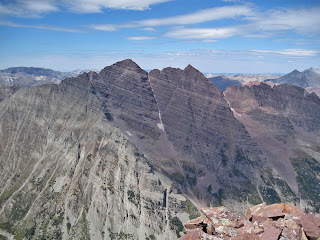 |
The Maroon Bells as seen from Pyramid Peak. The
"Deadly Bells" have been the sight of many deaths and
rescues over the years, including two more in 2016 |
July 10- Stephen Hunt, a 55-year-old man from Parker, Colorado, died after falling on Crestone Needle. Hunt was a highly experienced mountaineer who had climbed all of Colorado's 14ers (some several times) and was actively working on the "Centennial" list, Colorado's 100 highest peaks. Crestone Needle is considered by many to be one of Colorado's most difficult 14ers.
August 3- James Beckerich, a 70-year old man from Pennsylvania, died from a fall while descending from a failed attempt to climb 13,554-foot Fluted Peak in the Sangre De Cristo Mountains. Beckerich was an experienced mountaineer who had been a part of failed Everest and Aconcagua expeditions and was training for a climb in Washington State. He had previously summitted many prestigious mountains.
August 24- Eric Poehlman, a 46 year-old man from Vermont, died near the summit of Mt. Harvard of a heart attack. This is not an accident per se but an example of how the added pressures of altitude and exertion can exacerbate pre-existing health conditions that you may or may not know are present. He was an experienced 14er climber who had summitted 47 of Colorado's highest mountains.
September 7- Steve Sprowles, a 68-year-old man from Conifer, Colorado, died after a fall on North Maroon Peak. The Maroon Bells have earned their nickname "The Deadly Bells" and it seems at least one death occurs there every year. The rock is very loose and steep and their beauty makes them a popular destination for aspiring summitters, some of whom misjudge the objective dangers posed by these dramatic peaks.
September 20- Dave Cook, a 49-year-old man from New Mexico disappeared while attempting to complete the notoriously dangerous Maroon Peak-North Maroon Peak traverse. It is possible he was also trying to add Pyramid Peak as well. This disturbing incident is particularly troublesome because Cook has never been located. It is difficult to know exactly what happened to him. The Bells Traverse is a very difficult and treacherous route and Pyramid Peak is almost as dangerous. Attempting these mountains alone adds to the risk of such an endeavor. Dave's family has created a
facebook page for anyone that might possibly have knowledge of his whereabouts.
October 1- Scott Corliss, a 61-year-old physician from Greeley, Colorado, died after a fall on the Narrows section of the popular Keyhole Route of Longs Peak. The conditions on this day were reported as icy. This section of the highly popular route is quite exposed and has been the site of at least five deaths over the years according to a post on
Alan Arnette's website covering this incident.
CONCLUSIONS:
 |
Walking the infamous Knife Edge on Capitol Peak, a peak
that has caused a number of fatalities over the years |
It is hard to know what to conclude from the seven deaths reported above. One thing that jumps out at me immediately is that all of the deaths were men over the age of 46 years old. But what do we do with this? Is it just a reflection of the demographic that climbs mountains in Colorado? Does it illuminate the risk-taking nature of men as opposed to women? Or is it just a statistical anomaly?
It is also worth noting that three of the seven victims were from Colorado and the other four were from out of state and that six of the seven occurred on or near 14ers. These stats illuminate the growing popularity of "ticking off" Colorado's highest peaks not just with locals but people from out of state as well. Several of the climbers listed above were also highly experienced, which shows how it is not just the foolish or the inexperienced that get into trouble in the mountains.
In the end, we each choose to venture into the mountains full-knowing the risks that we are taking. The high places of the world are not meant for human habitation. Gravity pulls strongly from the steep, broken slopes of these majestic mountains. We learn what we can from accidents of the past and continue to venture forth in the aim of self-enhancement. It is up to us to determine if that hope is worth the level of risk we assume.
Stay safe out there!
RELATED STORIES
-
Statistical Analysis of 14er Deaths in Colorado This Decade
Visit THE ARCHIVE: A list of most of our articles sorted by department
Follow us on Twitter!
Copyright notice: This website and all its contents are the intellectual property of www.coloradomountaineering.com and its authors. None of the content can be used or reproduced without the approval of www.coloradomountaineering.com.
Climbing and mountaineering are dangerous!! Please see the DISCLAIMER page
For information about how to contact us, visit this link


