Showing posts with label exlanation. Show all posts

Sunday, March 17, 2013

Get Better at Rock Climbing... Today!

Climbing at the Sun Tower in Unaweep Canyon
Traditional climbing in Unaweep Canyon
Getting better at rock climbing, every climber wants to do it, not everyone knows how. There are some crazy theories out there, some good and some not as good. But if you really want to improve your climbing in the shortest time possible, there are a few tricks that will help you turn that project from a dream into a send. This article is a brief look at some time-tested methods that are guaranteed to make you a better climber.

I will break this article into several sections and end it with a sample one-month workout routine that will help you see results fast.

I. NON-CLIMBING TRAINING
An important aspect of training for climbing is conditioning your body to be in the ultimate shape for rock climbing. But what does this ultimate shape look like? Bulky and ripped with muscles?  Lean and slender? The truth is there is a good medium. Too much muscle is as bad as too little, as muscle is heavy and will weigh you down. Consider Ashima Shiraishi,  the young climbing prodigy who recently gained notoriety for being the youngest person to climb V13 and 5.14c. Ashima is very small and light, and her strength-to-weight ration allows her to make gymnastic moves on the tiniest holds.

One thing that is for certain, however, is that excess body fat should be your first priority. Unlike muscle it obviously doesn't add to your strength and acts like an anchor while on the wall. When I first started climbing, I was about fifteen pounds over my ideal climbing weight. Losing that extra flab alone allowed me to go from a shaky 5.8 climber to a shaky 5.10 climber. Chances are, you know if you are a little overweight. As a climber you have to be very lean to climb at your peak.
   A. Cardio/overall fitness
     Cardio fitness is important. It helps you shed excess weight and will help you build stamina. If you are overweight and need to lose some pounds, I recommend a vigorous cardio workout three or four times a week. This could mean a 40 minute run, an hour of hard swimming, or a difficult hike. Anything that gets you breathing hard and sweating and gets your heart rate up into the training range (about 80% of your max) for at least 30 minutes consistently. If you are already at or near an ideal weight, you can reduce this to two times a week and lessen the intensity.
   B. Muscle training
     Lifting weights has some benefit for climbing, but while building head-turning biceps might be good to impress the ladies (or guys) it does little to help you send that 5.12 project you've been dreaming about. Most of your muscle training should be focused on working muscles that oppose the most frequently used climbing muscle groups. For example, climbing is a forearm-intensive activity, so working out the extensor muscle group (the muscles opposite the forearm) with exercises such as reverse wrist curls will help keep you from becoming too lopsided and risking injury. Basic muscle exercises, however, like push-ups, sit-ups, wrist curls, lat pulls, etc, can have some benefit if you feel you are lacking in overall strength. Climbing, however, is the best training for climbing, as will be discussed in the next section.

A 5.12a sport climb at the Puoux in Glenwood Canyon
The author on Urban Cowboy (5.12a)
II. ON THE ROCKS
     The best way to become the climber you always wanted to be is to climb, and climb a lot. But haphazardly attacking the wall at your local gym, consistently flailing on climbs that are too hard for you, or climbing the same routes over and over, are all ways to slow your progress, and soon you will find yourself plateauing and wondering why you don't seem to get better despite how often you are tying in. Here are a few ideas regarding making the most your actual climbing time.
   A. On-sight climbing- One of the quickest ways to find yourself stuck on that proverbial plateau  is to climb the same routes over and over. The cure to this is simple: focus your time climbing on-sight! Always find new routes and new areas. The more rock you are exposed to, the easier you will be able to adapt to anything new you might encounter. Running laps on climbs you know by heart may be good for endurance, but your muscle memory is locked and you gain very little skill. Try to spend 2/3rds of your climbing time on rock that is brand new to you. At the gym, try climbing "random" routes where you pick your way as you go. Difficulty is less important than you might think, but exposing your body to new holds, new positions, and new sequences will make your skill level skyrocket.
   B. Projecting- Although it is good to spend most of your time climbing onsight, projecting has benefits too. For one, having a "dream project" helps keep you motivated and working hard to improve. It also challenges you to force your body to improve. You may discover new types of sequences that you never thought of. The key to projecting is not to become too fixated. Try your project for awhile and move on, but don't focus only on one climb.  Beware, however; projecting a climb that is overly difficult for you, one where you make very little progress on any given day, is not productive and a quick way to find yourself feeling stuck.
   C. Downclimbing- A highly neglected aspect of climbing. It is easy to reach the top of a route, feeling tired, as simply yell "ready to lower". If you do this, however, you are missing out on a chance to work on a necessary and valuable skill: downclimbing. Downclimbing teaches you balance and makes you think about the rock in ways you may never have thought of. I suggest doing it as often as possible. Just remember while downclimbing to be safe and don't try it on a route that might put you in danger.
   D. The Gym- Gym climbing is a good way to build your strength and work on technique in a user-friendly and relatively safe setting. However, the gym is not real rock, and spending too much time at the gym can actually hurt your outdoor skills in some ways. Gym climbing is good for bad weather days and the off-season. You can work out hard, get many reps in, and improve your skills. On the other hand, those neon holds are often not very much like what you will really encounter and make route reading far too easy. The best way to get better at real climbing is to climb outside as much as possible, and supplement this with indoor climbing when the outdoors aren't available.
   E. Rest days- Another huge mistake many climbers make is to climb too much. You must give yourself plenty of good days of rest. One key to remember is that you don't gain strength during workout days, only while you sleep and rest. If you are climbing hard 5 days a week you are breaking your muscles down and not allowing them time to rebuild. Your strength gains will not be as much as if you climb 3-4 days a week and allow your body time to recover.


Visit THE ARCHIVE: A list of most of our articles sorted by department

find us on facebook

Follow us on Twitter!

Copyright notice: This website and all its contents are the intellectual property of www.coloradomountaineering.com and its authors. None of the content can be used or reproduced without the approval of www.coloradomountaineering.com.

Climbing and mountaineering are dangerous!! Please see the DISCLAIMER page
For information about how to contact us, visit this link


Monday, February 4, 2013

5.9 Ain't What it Once Was: An Exploration of Grade Inflation in the Yosemite Decimal System

The Yosemite Decimal System is a complicated entity fully worthy of dissertation-like exploration. But the YDS is an empirical system not a intellectual one, and any attempt to reduce it to research and discussion is bound to be flawed. If you are new to the Yosemite Decimal System, a good place to start is our article from January 2012 that provides a basic understanding of its history and of its general grade ratings.

A 5.10a rock climb in Western Colorado
A 5.10a sport climb in Colorado
There is much discussion, particularly between the older and younger generations, about a particular YDS phenomenon in the climbing and alpine world often called grade inflation. I work occasionally as a route setter at a local climbing wall. After designing and executing a project I was sure (and was confirmed by three other climbing friends, all of which can onsight 5.10 and one of which who can onsight 5.12) was 5.10b/c, a climber that was 48 years old and has several decades of climbing experience suggested 5.9+ as the rating. Surprised by this, I voiced my doubt and had him try another climb nearby which I originally rated 5.11a but after a few ascents downgraded to 5.10d. Again, this was confirmed by the same three friends. After struggling a bit but finishing the climb, this 48 year old climber suggested once again that this climb was 5.9+, only adding this time that it was "maybe" 5.10a. I was shocked, and this time I protested saying that this rating was simply impossible. After a lengthy discussion, at best I could convince him that it was at least 5.10b but he would concede no higher. While I was thinking "sandbagger," he suggested perhaps the difference was due to "a different generation" in a smug tone I interpreted as elitist.

While this encounter is not proof of anything other than the subjective nature of any grading scale in general and the Yosemite Decimal System here in particular, it got me wondering about the familiar theory of grade inflation all over again. Does it exist and why? Visit beta websites that allow users to vote for "consensus" ratings on routes such as Kor-Ingalls on Castleton Tower or The Mace near Sedona, Arizona that were established several decades ago or more and you often find that the new consensus is higher, sometimes considerably, than the original suggested rating. Is it that modern climbers, influenced by the safety of clip and go sport climbing, have been softened by the loss of "boldness" from the mainstream climbing realm? Or that many climbers climb for years and never learn to place a cam or a piton?

True Grit (5.8) a sport climb in Unaweep Canyon, Western Colorado
While considering this question, my research took me to a broad spectrum of places. In order to understand the issue of grade inflation, it seemed vital to understand its history. As noted in our history article, the YDS scale was invented at Tahquitz Rock as an extension of the Sierra Club's terrain rating scale that was used to grade alpine routes of all levels (class 1 being trail walking and class 5 being technical climbing). Ratings were established from 5.0 (easiest technical climb) to 5.9 (hardest technical climb at the time). The climbs at Tahquitz Rock, therefore, became the baseline routes by which all others would be compared. However, when you review the history of the rating at Tahquitz, you find a peculiar thing: the original ratings, the ones that were supposedly designed to anchor the entire system, have migrated slowly and steadily upward.

White Maiden's Walkaway on Tahquitz Rock's Maiden Buttress is an 800 foot multipitch trad route that was established in 1937 as one of the baseline routes at the 5.1 rating. Subsequent guidebooks over the years show that the rating has slowly risen to 5.3 then 5.4 and now some guidebooks list it 5.5. A survey of the consensus votes on one popular beta website reveals that one quarter of the climbers suggesting 5.6. Has the scale really bumped five number grades? Would that mean that modern 5.15 is simply what 5.10 was in 1937? The short answer is yes... and no.

The truth is the scale has inflated. As it has been refined, the higher grades have become more important and useful by modern standards. After all, many climbers today will lead their first climb at 5.6 or 5.7. The difference between 5.0 and 5.2 is almost indistinguishable. In truth, everything from 5.0 to 5.4 is a vague blur and often seems to overlap with class 4. In the days before the scale was opened to the mathematically illogical 5.10 rating (subverting the notion that class 6 climbing was aid climbing) in the early 1960's, when a climber encountered a climb that was at the very limit of the time it had to be rated 5.9. Sometimes the most devious of these would get a feeble 5.9+ modifier. That's not to say all 5.9's were the same, they just had no other rating to apply to these cutting edge climbs. When the scale finally opened, it was ultimately refined and slowly expanded as the sport advanced.

Today, the YDS and other scales are continuing to expand together. The YDS and the French scale, for example, have locked in step progressing at identical increments as a small group of international climbers establishes and confirms new futuristic climbs. As the grades expand slowly, one letter increment at a time, and benchmark routes are established at the new grades, the scale(s) have become more refined than in the older days. The aforementioned grade inflation does not seem to occur at these higher grades, and certain routes that have been held up as examples of certain grades have rarely changed over the years. If anything they tend to get downgraded as the beta develops and more ascents are made.

grade inflation in the YDS system for grading rock climbs
The author on a 5.12 (or is it 5.9+?)
sport climb in western Colorado
What all of this seems to mean is that modern climbers are not soft compared to their predecessors, despite the explosion of popularity in the safer mode of sport climbing. What the sport climbing explosion has allowed for is climbers to focus on pure difficulty, and people are sending routes that those who established the YDS scale could never have imagined 80 years ago. While the lower end of the scale might be softer than it was decades ago, the upper end of the scale has now been pushed higher than ever in all aspects of the sport, not just in bolt protected sport climbing. The so-called world's hardest off-width, The Century Crack (5.14b), was free climbed in Canyonlands National Park in Utah in 2011, as well as the hardest trad line in famed Indian Creek: Carbondale Short Bus (5.14- PG-13). Bold alpine first ascents have occurred in the Ruth Gorge in Alaska and elsewhere across the world. Alex Honnold soloed Half Dome, El Cap, and Mt. Watkins in a single day. While the sport has gone mainstream and become safer in many ways, boldness is still very much alive and rewarded. Though grade inflation has occurred notably over the decades in the lower grades, the higher grades have remained relatively stable, only expanding as new generations are able to push the sport further and further into the future.

Visit THE ARCHIVE: A list of most of our articles sorted by department


find us on facebook

Copyright notice: This website and all its contents are the intellectual property of www.coloradomountaineering.com and its authors. None of the content can be used or reproduced without the approval of www.coloradomountaineering.com.

Climbing and mountaineering are dangerous!! Please see the DISCLAIMER page
For information about how to contact us, visit this link


Thursday, January 24, 2013

Spring Loaded Camming Devices (SLCDs): An Explanation of the Modern "Cam"

The invention of the spring loaded camming device (commonly called simply "cams") in the 1970's revolutionized the climbing world. The ability to quickly and safely protect parallel-sided cracks opened up the world of traditional climbing to whole new realms. Perhaps no single gear invention, except maybe sticky rubber, has so directly affected the type and difficulty of routes that climbers are able to attempt. This article examines the world of spring loaded camming devices.

Trad gear
 trad gear with a smattering of cams
I. HISTORY OF THE CAM (SLCD)
The invention of cams was progressive in nature, but the first patent for a spring loaded camming device was filed by Greg Lowe in 1973. It wasn't until Ray Jardine took this idea, however, and developed his version in 1978 did the use of cams truly begin. Jardine called these original units "Friends". Although technology has developed with cams to make them more user friendly, versatile, or specialized to a particular type of crack, modern camming units work much the same as the original Friends.

Today there are several manufacturers that make their own version of the SLCD, especially Wild Country, Black Diamond, Metolius and a few others. Most companies have several different types of cams that serve different purposes, i.e. cams that are wider with more surface contact to spread the load on softer stone, or cams that have flexible stems for awkward and horizontal placements. All cams, however, function based on the same basic principles of physics.

II. CAM USE 101

Properly placed with the apex of the rounded lobes oriented at 90 degree angles from the orientation of the stem (see figure a), cams function by the action of the stem pulling on the rounded lobes of the cam which rotate and become locked with opposing outward force. The outward force generated is two times the downward force, which generates enough friction when properly placed to protect even a very nasty fall. A perfect cam placement is very solid but relies on a few key components.

The first key element is the rock itself. Not even a perfect placement is worth anything if the rock isn't strong enough to withstand the high forces generated in big fall. For this reason, avoid detached flakes and exceptionally brittle sandstone or other soft rock types.

cam placement
(figure a.) a cam in a mock crack
with near perfect retraction
The second key element is shape of the crack which you are protecting. In perfectly parallel cracks, cam placements are easy. Sink them firmly in but not too deep so that they might walk deeper and become irretrievable. In jagged, angular cracks, finding the best spot to place a cam can be tricky. It is best to place a cam in the most parallel-sided part of a crack as you can find, avoiding being near flares, widenings or pockets or anywhere the cam could walk out and become dislodged. It is best to find a placement with constrictions above and below to avoid this possibility.

The third key element is the correct sizing and placement of the cam. Ideal placement is when the cam is between 50 and 90 percent retracted. Some cams have indicators showing you when a cam is at its ideal angle. It is also important to place the cam deep enough without making it hard to retrieve as well as orienting the stem in the anticipated angle of a possible fall. Keep in mind, this is only a very basic overview and mastering all of this takes many hours of practice.

III. DIFFERENT TYPES OF CAMS
As mentioned above, there are many different types of cams on the market today and knowing which is best depends a lot on you. At a basic level, modern cams consist of a stem and a set of either 3 or 4 lobes. Three-lobed units have a narrower head and can therefore fit in small points in the crack. Four-lobed units have more surface area and therefore have more holding power. It is also possible to buy offset cams where the lobes are wider on one side than the other. These specialty cams are the best way to protect flaring cracks where regular cams might not suffice. Another specialty variation is the flexible stem which allows the cam to better redirect forces when protecting horizontal cracks and other misshapen features.

Cam sizes comparison
A comparison of common sizes from large (Black Diamond Camalot C4 size 5),
medium (Black Diamond Camalot C4 size 1), and very small (Black Fixe Hardware Alien)

Comparison of cams
A comparison of the head width between a 3-lobed and 4-lobed cam of similar size
IV. CONCLUSION
Camalots are a modern trad climbers best friend. They are the technological development that allow us to climb parallel sided cracks with ease and confidence as well as allow us to climb "clean" without using rock-damaging metal gear like pitons and nails. Learning how to properly use cams is a crucial part of today's trad climbing world. While all cams are the same at their core, there is a lot of variation between different companies as well as different models of cam within the same company. Make sure to do plenty of research, bearing in mind your own climbing ability and style before investing in a set of cams to fill your rack.

V. FURTHER RESOURCES
When considering what kind of cam you want to add to your rack, it is important to do your research. Here are a few sources to further your understand of SLCDs and what is available on the market:

Rock Climbing Anchors by Craig Leubben- On Amazon.com

Black Diamond's official page covering rock protection

Wild Country's official page covering their rock protection

Metolius's official page

find us on facebook

Copyright notice: This website and all its contents are the intellectual property of www.coloradomountaineering.com and its authors. None of the content can be used or reproduced without the approval of www.coloradomountaineering.com.

Climbing and mountaineering are dangerous!! Please see the DISCLAIMER page
For information about how to contact us, visit this link


Saturday, January 7, 2012

A Guide to the Yosemite Decimal System

INTRODUCTION


I am often asked by friends new to mountaineering or climbing just what the grade numbers mean. What is the difference between class 3 and class 4? What is the difference between a 5.7 climb and a 5.10 climb? Just what is a 5.15? And what about those letters? Is it really possible to accurately and effectively subdivide a grade like 5.10 into four, lettered subgrades? Not to mention Aid and protection ratings and the vague Roman numeral grades. This article is an attempt explore a very complex and dynamic grade scale that is the Yosemite Decimal System for grading terrain.

You hear a lot of numbers thrown around in discussions of route difficulty. It's important to remember that any attempt to reduce something as complex as a mountaineering route to a few numbers is bound to be flawed. Any class rating is an oversimplification at best and is certainly not capable of telling the full story about the route you will experience. Attitude, body shape, climbing style, etc, will play major factors in a route's perceived difficulty. Difficulty ratings also don't incorporate other issues, such as protection, rock quality, belay/rappel anchors, weather conditions, rock conditions, etc. Difficulty ratings are also subject to local interpretation, and you might here terms like "soft" or "sandbagged" applied to certain crags. In my backyard, Rifle Mountain Park--a famous limestone sport climbing area--is often called "sandbagged", meaning that the grades climb harder here than other places.

It is also important to note the difference between gym, sport, traditional (trad), and alpine climbing. A person comfortable at 5.10 on bolts or at the gym may panic on a 5.7 trad climb. Alpine routes especially bring their own unique difficulties, and even low 5th class (which I have labeled as "easy") can be quite advanced considering the length of these routes and the objective hazards of a mountain environment. Always seek as much information as you can before attempting a route. Consult locals, buy route guidebooks, and surf your favorite web-beta climbing site to maximize safety.

That being said, difficulty projections are useful to gain a rough idea of the technical demands a given route will entail. A knowledge of the scale, therefore, is important. Consider the following article as a rough guideline to understanding the current system for grading terrain in the United States. Bear in mind two things about my opinion of these grades: I have a Western Colorado bias, which might compare to your local understanding in different ways. Our climbs might be rated harder than yours, or they might be easier. It is hard to say. The truth is, however, that the only way to really understand a grading system such as the Yosemite Decimal System is to experience the rock and subsequent ratings for yourself.

Class 1Class 2Class 3Class 4Class 5

HISTORY

The original Yosemite Class System was created by the Sierra Club in the 1930's to taxonomize the difficulty of various hikes in the Sierra Nevadas. Class 1 was simple  trail walking, and class 5 was considered technical climbing. It was soon discovered that class 5 encompassed such a large group of rock that it was sub-divided into a decimal system. This decimal extension was created and developed in Southern California to classify the difficulty of various routes at Tahquitz and Suicide Rocks. The "old-school" scale started at 5.0 was capped at 5.9. As climbers and their gear got better, even harder climbs were being sent, and the need arose to open the scale. The YDS scale has now been pushed to 5.15c, though only a handful of such routes exist in the world.

YDS CLASS

General terrain difficulty grading system (U.S.):

Difficulty LevelTypeDescriptionAlpine Examples
Class 1Trail walkingThis includes everything from paved concrete at the easier end of the level to very steep but well-defined alpine trails. Using your hands for balance even occasionally is usually not necessary. Mt. Elbert, Northeast Ridge;  
Class 2Off-trail hikingUneven terrain or very rough trails that require considerable attention to footwork. Hands are possibly used on occasion for balance but not relied upon for significant periods. Torreys Peak, South Slopes; Holy Cross North Ridge
Class 3ScramblingHands are now used for upward movement continuously. Holds may be selected and tested but are plentiful and very easy to grip. Third-class terrain is probably never fully vertical. Most people do not need a rope to ascend class 3. An indicator of class 3 is that most people can downclimb it facing outward.Longs Peak, Keyhole Route; Mt. Evans, The Sawtooth
Class 4Hard scrambling/easy climbingHands used continuously for upward movement. Class 4 is sometimes close to vertical but has very good and abundant holds. Some people may want a rope on class 4 terrain but most will not. A key difference between class 3 and 4 is that many people feel the need to downclimb class 4 facing inward.Capitol Peak, Northeast Ridge; Pyramid Peak, Northeast Ridge
Class 5Technical climbingRequires considerable knowledge of ropework, knots, and protection to climb. Although "free-soloing", or climbing without a rope, is admired and even revered by some as the purest form of climbing, it is a rare sort of person that enjoys climbing significant class 5 pitches without a rope. Most people will want rappel, not downclimb, a class 5 pitch, especially if it is of significant length. Longs Peak, North Face; Vestal Peak, Wham Ridge


A 5.12a sport climb in Colorado

5.8+ dihedral in Colorado National Monument
5.7 trad near Carbondale


A breakdown of the YDS 5th class subgrades:

Difficulty LevelTypeDescriptionExamples
5.0-5.4Easy climbingFace: Very good and plentiful holds. This is generally considered "easy" climbing. Usually less than vertical with large jug holds or many otherwise positive holds. Sometimes there seems to be some overlap with easy class 5 climbs and harder class 4 climbs. Short sections of low class 5 are often soloed by experienced climbers.

Crack: It is hard to find a crack that is sub 5.6. If there is such a thing it is almost assuredly sub-vertical and accompanied by numerous face holds.
Longs Peak, North Face; Vestal Peak, Wham Ridge
5.5-5.6Easy moderateFace: Getting a little more challenging now. Often vertical with very good and plentiful holds or slabs with easy-to-find edges. Holds are abundant for climbers of any height and almost ladder-like in quality.

Crack: Probably sub-vertical and likely with plentiful accompanying face holds. Solid comfortable, jams throughout and very little "awkward" places.
Spearhead, North Ridge; Lumpy Ridge, Batman and Robin
5.7-5.9ModerateThis is probably the most popular range and the domain of the weekend warrior. Reasonably athletic, first-time climbers with no experience can sometimes climb at this level on top rope, especially 5.7s and 5.8s. In the alpine realm, however, these routes can be quite advanced.

Face: Plentiful holds that are mostly positive. Climbs of this range can be fully vertical but are almost never overhanging. Some 5.9s could possibly be overhanging for very short sections.

Crack: Just sub-vertical to vertical cracks in the good sizes, espcially thin to perfect hands. Sometimes fingers, espcially if face holds present.
Petit Grepon, South Face; Crestone Needle, Ellingwood Arete; Independence Monument, Otto's Route
5.10-5.12AdvancedRock of this level requires considerable technique and skill. Many climbers never achieve this level, 5.12 in particular. Usually requires considerable time investment to acquire. Routes rated 5.10 or above are usually subdivided into letter grades a, b, c, and d. Though there is often much debate over these letter grades, there is a noticeable difference between a 5.10a and a 5.10b. This is an elite level for trad climbing, as many people climb one or two number grades lower when placing gear.

Face: Requires use of very small holds, crimps, side-pulls, gastons, underclings stemming, etc, a great deal. 5.10s can be overhanging with very good holds. 5.12s are often overhanging with technical movement like dropped knees, etc. 5.12 slabs are very blank.

Cracks: Very difficult cracks with the bare minimum of accompanying face holds. 5.12 cracks are often in the ringlock size or in a better size but overhanging.   
Longs Peak, Casual Route; Sunlight Spire, Standard Route;Eldorado Canyon, The Naked Edge
5.13-5.14Elite Let's face it, climbing at this level is for the very best. Poor holds, monster overhangs, little rest, gymnastic ability, all qualities you are likely to find on a route at this level. Climbing 5.13s and 5.14s requires many hours of dedicated perseverance and considerable natural ability.

Face: This is hard for me to say, I have never climbed at this level, though I have seen a lot of 5.13 and some 5.14 climbs. They are almost always overhanging and requiring amazing use of body position to utilize angled sloper grips. A 5.13 slab is extremely rare.

Crack: Gnarly tips cracks, possibly overhanging, no face holds. There really arent a ton of cracks of this level out there. Overhanging off-widths can get this rating, like Belly Full of Bad Berries in Indian Creek. Recently, the supposed "hardest off-width in the world" was put up in Canyonlands National Park, Utah. Dubbed "The Century Crack" it is a heinously long, flat overhanging off-width that was freed and given a 5.14b rating.

Check out this video of Mason Earle tackling Squamish's Cobra Crack, one of the most famous 5.14 trad climbs in the world. 
Rifle Mountain Park, Zulu; Clear Creek Canyon, Prime Time to Shine
5.15VirtuosoVery few climbers in the world have ever achieved this level and all are essentially household names. Chris Sharma, Tommy Caldwell, Dave Graham, Adam Ondra, and a handful of others complete the list. Though Tommy Caldwell never graded it officially, Flex Luthor, a sport climb in Colorado, was generally considered the first 5.15 in the United States. Caldwell redpointed the route in 2003, and only commented that it was "significantly harder than [neighboring] Kryptonite", which was the first route in the U.S. graded 5.14d. Luthor has yet to be repeated and thus the rating un-confirmed. Here is a video of Chris Sharma and Adam Ondra working what is now known as the hardest climb in the world.Fortress of Solitude, Flex Luthor, La Dura Dura, Spain


5.7 granite trad climb in Unaweep
5.10b overhang on the West Slope

SAFETY/PROTECTION RATINGS

Since the YDS system accounts only for the technical difficulty of the hardest move, a need arose to somehow quantify the quality of protection, and therefore safety, of a given route. Consequently, James Erickson developed a safety grade based on movie ratings. It is important to note, however, that these ratings are given with the assumption that the leader has placed gear perfectly as the route allows. In other words, in inexperienced hands ANY climb can get the most dangerous rating.

G: Good. Protection is more than adequate, with placements available to minimize the fall factor. A leader who places gear properly should never be in danger of hitting ledges or the ground in the event of a fall.

PG: Pretty good. Protection is considered adequate, although moments where there is ledge-fall potential may exist. It is rare to see either a G or PG rating attached to a climb, as it is only when a climb is PG-13 or higher is it noted in guidebooks.

PG-13: Moderate. Protection is generally good with perhaps a section where there is potential for a long, risky fall. This rating is often applied when protection for a climb is not totally adequate but not bad enough to merit a full R or X rating.

R: Runnout. Even with perfect gear placements there are long sections of unprotected rock where if a lead climber fell they would be subject to a long, dangerous fall likely resulting in serious injuries.

X: Extremely runnout. Similar to the R rating, only taken to an extreme. If a leader falls on an X-rated climb, death is a real possibility.

GRADE RATINGS

The American system also includes a Roman numeral "grade" that attempts to evaluate a climb in terms of both time required and technical difficulty. The grading system attempts to combine factors such as: length, commitment, routefinding, difficulty of hardest pitch, average pitch difficulty, number of technical pitches, and others.

Grade I: Short climb requiring a couple hours or less of any difficulty. Single or two-pitch climbs are usually graded I though the numeral is not usually included on the difficulty rating.

Grade II: Half a day to 3/4 of a day of any difficulty. Most 14er hikes in Colorado are graded as II. Otto's Route on Independence Monument near Grand Junction, Colorado is usually graded II.

Grade III: Most of a day with some technical climbing. Long semi-technical climbs such as Ellingwood Ridge on La Plata Peak in Colorado can also receive a Grade III rating.
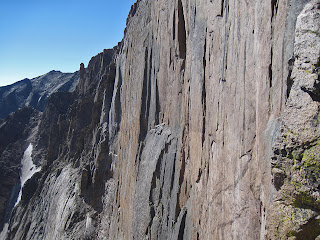
Longs Peak's The Diamond
Grade IV: A full day of technical climbing with the hardest pitch being at least 5.7 in difficulty. The Casual Route on Longs Peak is Grade IV.

Grade V: Requires a day and a half with the hardest pitch being at least 5.8 in difficulty. Very long multi-pitch climbs often requiring aid climbing. The Yellow Wall on the Diamond is usually graded V.

Grade VI: Multi-day climb with many technical pitches requiring difficult free climbing and aid as well. Most of the famous routes on El Cap in Yosemite are Grade VI as well as climbs such as the Hallucinogen Wall in Black Canyon National Park and the North Face of Mt. Hooker in the Wind River Range.

Note: While the grading system specifically lists criteria such as "takes multiple days," advances in the sport have proven these factors as unreliable. Grade VI routes on Halfdome and El Cap, after all, have been climbed in a day or less by modern pioneers.

AID RATINGS

The last component you are likely to see in a rating for a climb in the United States is an aid rating. Aid climbing occurs when terrain becomes too difficult for a leader to climb free and resorts to climbing on gear itself, rather than the rock. Pitons, gear grabbing, etriers, cam hooks, etc, are all components of aid climbing. Personally, I don't do a lot of aid climbing as of now, so the following descriptions are greatly in-debted to Mountaineering: The Freedom a the Hills, a book that anyone interested in alpine climbing should own, and several other sources.

A0: Fixed protection in place, such as a bolt ladder. Sometimes when a free climber pulls on a quickdraw or camalot they will say they did some "A0" on that particular climb.

A1: Easy aid placements, and almost every placement is capable of holding a fall.

A2: Generally good placements, but they may be difficult to place. Intermittent bad placements are also possible.

The Titan, home of the famous aid route Sundevil Chimeny (5.9 A 3)
A3: Hard aid. Requires active testing of placements. Each pitch takes a very long time to lead and there is potential for some very big falls, up to around 80 feet or so. Most falls, however, are not particularly hazardous.

A4: Serious aid. Big half-rope length falls with potential for grounding. The vast majority of placements are only capable of holding body weight. In a sense, this is almost like the "R" rating in the safety section.

A5: Placements hold only body weight for an entire pitch. Any lead fall for the entire pitch is going to be factor 2 (i.e. twice the length of the rope that is out) or the fall will directly ground the leader. Comparable to the "X" rating in the safety section.

A5+/A6: Occasionally people have proposed an A6 grade for several climbs, though many deny the possibility that such a grade can exist. Supposedly, and A6 climb is like an A5 with body weight placements for an entire pitch but with bad anchors as well.

Aid climbs can also be rated C0-C5 which means basically the same thing except that a route can be climbed without the use of pitons, bolts, or drilling. This category is called "clean aid". Once a route has gone clean it is expected that subsequent climbers will honor this style and not further mar the rock.

This article, written by Richard Jensen, is an intriguing read and will help provide an empirical understanding of aid climbing. Further investigation of climbing figures like Royal Robbins, Warren Harding, Jim Beyer, Layton Kor and others will help you understanding more about the sport of aid climbing in America and its illustrious history.

CONCLUSION

Clearly, the system for rating the difficulty of a climb is complicated and takes a long time to master. There is plenty of room for subjectivity and debate. One person's 5.7 is another's 5.9. While some people shun such ratings debates, I actually find them interesting, as long as people do not take them too seriously. True climbers wont waste too much time in rating's debates but instead will be out on the rock, having fun no matter what a climb is "rated". Still, after reading this article you can look at a rating such as IV 5.10c R A3 and have an idea of what to expect from such a climb.

APPENDIX A- Comparison chart for difference difficulty grades:

YDSV-ScaleUIAAFrenchFont.
5.0--II----
5.1--III1--
5.2--III2--
5.3--IV3--
5.4--IV4a--
5.5--IV+4b--
5.6VB-V4c1
5.7VBV+5a2
5.8VB+VI-5b3
5.9V0-VI5c3+
5.10aV0VI6a4
5.10bV0VI+6a4
5.10cV0+VII6a+4+
5.10dV1VII6b5
5.11aV1+VII+6b+5
5.11bV2VII+6c5+
5.11cV3VIII-6c+6A
5.11dV4VIII7a6A+
5.12aV4VIII7a+6B
5.12bV5VIII+7b6C
5.12cV6IX-7b+6C+
5.12dV6IX7c7A
5.13aV7IX7c+7A+
5.13bV8IX+8a7B
5.13cV9X-8a+7C
5.13dV9X8b7C
5.14aV10X8b+7C+
5.14bV11X+8c8A
5.14cV12XI-8c+8A+
5.14dV13XI9a8B
5.15aV14XI+9a+8B+
5.15bV15XI+9b8C

FURTHER READS

-14ers are Dead!!!
-Hardest Move vs. The Route as a Whole: A Discussion of Grading Difficulty
-Ten Class 3 Colorado Classics
-Ten Class 5 Colorado Classics
-Five Hardest 14er Cruxes

Visit THE ARCHIVE: A list of most of our articles sorted by department

find us on facebook

Follow us on Twitter!

Copyright notice: This website and all its contents are the intellectual property of www.coloradomountaineering.com and its authors. None of the content can be used or reproduced without the approval of www.coloradomountaineering.com.

Climbing and mountaineering are dangerous!! Please see the DISCLAIMER page
For information about how to contact us, visit this link