

Showing posts with label sport climbing. Show all posts
Showing posts with label sport climbing. Show all posts
Sunday, October 8, 2017
VIDEO: Boulder Woman Makes First Female Ascent of a Confirmed 5.15
This didn't take place in Colorado, but Boulderite Margo Hayes became the first woman to climb a confirmed 5.15 this year when she climbed Chris Sharma's mega-classic La Rambla. This short video is a teaser of that historic climbing moment.


Wednesday, October 22, 2014
VIDEO: Hardest Rock Climb in the World
This post is being made as a reference and for its history. While sport climbing and mountaineering are quite different pursuits they are related and since both use the same grading scales for difficulty this video of Chris Sharma and Adam Ondra taking on and both completing the most difficult climb in the world currently, La Dura Dura (5.15c)
RELATED
-Hardest Climb at Indian Creek
-Explanation of Yosemite Decimal System
-The Future of Rock Climbing and Mountaineering

Follow us on Twitter!
Copyright notice: This website and all its contents are the intellectual property of www.coloradomountaineering.com and its authors. None of the content can be used or reproduced without the approval of www.coloradomountaineering.com.
Climbing and mountaineering are dangerous!! Please see the DISCLAIMER page
For information about how to contact us, visit this link
RELATED
-Hardest Climb at Indian Creek
-Explanation of Yosemite Decimal System
-The Future of Rock Climbing and Mountaineering
Visit THE ARCHIVE: A list of most of our articles sorted by department
Thursday, November 21, 2013
VIDEO: Midnight Run, New 5.13d in Glenwood Canyon
A video of climber Logan Jauernigg on his new route Midnight Run, a 5.13d sport climb at the Puoux crag in Glenwood Canyon.
Midnight Run: First Ascent from Björn Bauer on Vimeo.
Visit THE ARCHIVE: A list of most of our articles sorted by department
Copyright notice: This website and all its contents are the intellectual property of www.coloradomountaineering.com and its authors. None of the content can be used or reproduced without the approval of www.coloradomountaineering.com.
Climbing and mountaineering are dangerous!! Please see the DISCLAIMER page
For information about how to contact us, visit this link
Midnight Run: First Ascent from Björn Bauer on Vimeo.
Visit THE ARCHIVE: A list of most of our articles sorted by department
Monday, September 16, 2013
The Next Level: The Future of Climbing and Mountaineering
 |
| Chris Sharma on La Dura Dura (5.15c). Screenshot from BigUp's Reel Rock 7. |
There are only a handful of climbers in the world who can climb 5.15. The list is limited to names like Alex Megos, Ramon Julian, Dave Graham, Adam Ondra and, of course, Chris Sharma. Undoubtedly there are a few others, but this very small list shows just how hard the grade is. If these climbers, people like Sharma and Ondra, find these climbs to be at the very limits of their abilities, taking months of rehearsal and many many attempts to complete, just how much more difficult can climbing get? Have humans now reached the limits of physical capacity where, short of developing sticky pads on our fingers or some improbable gear innovation, we simply are not able to climb anything harder? Will we ever see a 5.15d or even a 5.16? How about bouldering? V16? V17? The alpine realm seems more open, with many peaks out there that still have yet to be climbed. But eventually, it seems, humans will soon have stood on every high point in this wide world. What then? Are the sports of climbing and mountaineering destined to fall in decrepit mediocrity without the excitement of progress? Already here in Colorado there are no exciting peaks still awaiting a first ascent. Even finding a new line on any of the major peaks is going to be hard to impossible (though Tommy Caldwell and Joe Mills did establish the first 5.14 line on the Diamond one month ago). Or will someone in the next generation prove that what is considered possible is never capped?
 |
| Cerro Torre, where Hayden Kennedy and Jason Kruk made the first "fair means" ascent of the in famous Compressor Route. Photo courtesy Wikimedia Commons. |
Another young climber who is proving that there are other ways than just pure difficulty which the sports of climbing and mountaineering can expand is Alex Honnold. In 2008 Honnold made the first free solo ascent of the Regular Northwest Face of Half Dome (VI 5.12b), climbing the 23-pitch route without a rope. Honnold's achievements have proven that newer generations of climbers are still willing to push the sport in "bold" directions. In 2012 Honnold managed to achieve a solo link-up Half Dome, the Nose and Mt. Watkins in a single day.
Modern Yosemite pioneer Tommy Caldwell also continues to push the sport of climbing. At 35 years of age, Caldwell has done more to push the sport of rock climbing to new levels than almost any one. In 2003 he put several months of hard work into a massive, overhanging cave on a remote wall in western Colorado, establishing Kryptonite, the country's first 5.14d (9a), and Flex Luthor, quite likely the first 5.15 in North America though it remains unrepeated and unconfirmed to this day. In recent years, Caldwell has been back where he feels most comfortable, on big walls, freeing old aid lines on Colorado's Diamond and Yosemite's Half Dome and El Capitan. Caldwell's free version of Mescalito on El Capitan, if completed, could be the hardest big-wall free climb in the world.
And what about the next generation? Young climbers today are better than ever. A crop of super-young, highly talented climbers are already scaling the best rock in the world, threatening to push the boundaries of a sport that has been accused of stagnation. 12-year-olds Mirko Caballero and Ashima Shiraishia have both climbed V13. Ashima, in fact, became the youngest person to climb that grade when she sent Crown of Aragorn at Hueco Tanks State Park, Texas at the age of 11. Other young climbers like Brooke Raboutou and Kai Lightner and others are all also climbing 5.14 and are all under 14 years of age.
 |
| The Ruth Glacier in Alaska. Photo courtesy Wikimedia Commons. |
With all the growth in the sports of climbing and mountaineering, it is easy to think that we are reaching the limits of what is possible for a human. There are only so many mountains to explore. Someday soon we will have climbed them all. On the other hand, progressing into harder and harder difficulty too seems capped by simple human physiology. We can only hold onto to holds so small. Yet, despite these constraints, it seems that a new generation continues to surprise, finding and sending harder and harder climbs, or re-hashing old climbs in new style. Though maybe someday we will find that limit, for now the world of climbing and mountaineering continues to thrive.
Check out this video of Adam Ondra and Chris Sharma battling for the first ascent of La Dura Dura (5.15c):
Visit THE ARCHIVE: A list of most of our articles sorted by department
Sunday, March 17, 2013
Get Better at Rock Climbing...Today! (Page 2)
 |
| V4 boulder problem in Western Colorado |
There can be no doubt that climbing is almost equally mental as it is physical. So when is your mental state getting in the way? And what can be done to improve it? Here are a few tips to help improve your mental climbing acuity.
A. Fear- All climbing inevitably engages some degree of fear. Fear is good; it stimulates adrenaline which helps you focus and sharpens your body's abilities to perform. This is why we have adrenal glands in the first place. Only a great fool would call themselves a "fearless" climber. Those are the sort of climbers I don't like to partner with. However, excessive fears are debilitating and will ultimately hinder your ability to climb at peak performance. Two types of fears in particular are especially non-productive: fear of failure/embarrassment, and the fear of falling. Both of which are quite common and somewhat easy to remedy.
Fear of Failure- this is perhaps the silliest and easiest type of fear to rid yourself of. Being afraid of looking bad in front of your friends will hurt your performance. Don't hold yourself to the standards of others. While some friendly competition against your friends and/or peers will help keep you motivated, climbing is an individual sport. Measure your success against yourself only. Remembering that you are trying mainly to have fun and not send every climb you attempt the first time is a good way to keep yourself from falling into this trap.
Fear of Falling- this is a common and natural fear, and one that stands in the way of many climbers, especially ones that are at the beginner/intermediate level. While it is important not to ignore the possibility of a dangerous fall, being afraid to fall on well-protected routes is a major hindrance for your climbing. It will keep you from attempting routes at the top-end of your skill level and create a mental block on your climbing progress. This is evident for some climbers who will struggle with a certain move while leading but will fire through the same move when on top-rope. The best way to get over your fear of falling is to fall. Find a good belayer who knows how to perform a safe "soft catch" and take a few lead falls. On a safe climb, start with some short falls in the 5-8 foot range and build up to 15 footers. Soon you will learn to embrace and even enjoy falling and this fear will no longer be present.

Another important aspect of your mental conditioning is learning to focus. There are many techniques for focusing your mind, and you may have to find the ones that work best for you. Most trainers in athletics of all types, however, will teach you a combination of visualization, breathing, and meditation. Instead of staring up at a climb you are about to attempt convincing yourself it is too hard for you and imagining all the things that could go wrong, instead convince yourself that the route is within your ability and you are in the best condition to do it. Picture yourself making the moves in detail. Imagine yourself succeeding, standing at the top of the climb having sent it. And remember that if you don't there is always tomorrow. During the climb, if you find yourself starting to lose your focus, take a moment to breath a few times and re-channel your energy. Most of all, remember that climbing is fun.
IV. NUTRITION
Much can be said about nutrition and sports training, so I would go into too much detail here. Good nutrition, however, is a crucial part to getting your body to perform at its optimum levels and is therefore extremely important if you are training to climb. Eat well before a climb and after and you will find yourself feeling better and performing like you never dreamed. For the sake of this article I will break nutrition down into two categories: things that are good to eat, and things that aren't. For a more detailed nutrition regimen I would suggest seeking out any number of great resources that are already available.
THINGS TO EAT:
-Good carbs (in moderation) such as whole grains, oats, pastas.
-Foods high in healthy fats such as avocados, olive oil, etc. Remember that good fat is good and not all things that are "Low Fat" are healthy. Fat keeps your body satisified longer than carbs, making you feel hungry less often.
-Fruits and vegetables (but everybody knows this). If you struggle with the veggies, I suggest making smoothies or finding a taste for drinks such as V8.
-A high quality protein source is also crucial, lean meats relatively low in fat like chicken or turkey consumed as soon after a hard workout as possible will help your muscles recover and grow stronger. Protein supplements like Whey powder can also be helpful but avoid consuming too much protein, as it can lead to conditions such as gout.
THINGS NOT TO EAT:
-bad carbs high in refined sugars like soda, candy, milk chocolate, cakes, or any sweets. This group of foods is perhaps the worst thing you can consume for your body.
-Excessive amounts of saturated fat such as fatty red meats, butter, etc.
-And avoid excessive amounts of alcohol and drugs, these will certainly NOT help you to send that project!
V. SAMPLE ROUTINE
Here is a sample workout routine that can be customized to suit your particular climbing needs and current physical conditioning. This particular workout lends itself to gym climbing where you can climb a lot of pitches in a short amount of time, as well as mix sport and/or trad with bouldering. However, this routine can be customized based on what you have available at your local climbing areas.
1. Cardio-
A. 40 min jog. 5 min warm-up. 30 min running at a sustainable pace, gradually building in intensity followed by a 5 minute cool down walk. 3-4 times per week.
2. Climbing-
A. 50 feet of easy warm-up climbing 2-3 number grades lower than your hardest redpoint.
B. 250 feet (2-3 single pitch routes of 50-100' length) of onsight climbing from one letter grade to one number grade below your hardest redpoint (i.e. if your hardest redpoint is 5.11b, climb 5.10b to 5.11a onsight).
C. 100 feet of downclimbing
D. 75 feet of a project climb at or near your redpoint level. (recommended max: 5 attempts)
Or
5-10 boulder problems at or near your redpoint levelE. 2-5 boulder problems with 15-25 pounds of weight (either in the form of a weight belt or a partially loaded backpack. Could also substitute 50-100 feet of weight routed climbing 2-3 number grades below your redpoint limit. (Avoid strenuous crimps while weighted as they can cause tendon injury. Instead focus on jug holds and other "open" grip positions).
F. 2 sets of 100 foot "sprints", climbing routes that are easy for you (3-4 number grades below your redpoint limit), focusing on moving fast without resting but still maintaining good form.
NOTE: It is recommended to alternate spending one day focusing on power and projects and the next focusing on reps and endurance on lower grades. Customize your routine to find and work your strengths and needs.
3. Muscle-
A. Push-ups- 2 sets (enough reps that push your muscles to near failure)
B. Sit-ups- 2 sets
C. Wrist curls- 2 sets (enough weight to cause muscle failure in 20-30 reps).
D. Reverse wrist curls- 2 sets
E. Other- consider your personal weaknesses. For example, if your weakness is pure strength focus on lat pulls, bench press, bicep curls and other strength exercises.

All of this is a very brief and abridged theory about getting better at climbing. If you are serious about improving your climbing ability, I would suggest using this article as only one reference. I recommend reading broadly about the topic. Motivation and passion will go a long way toward helping you reach your climbing goals. If you start to find that climbing is not becoming fun, stop and re-evaluate what you are doing. Be honest and trying to pinpoint the source of your feelings. Although training is not always enjoyable, keep your eyes on the prize and always remember that climbing is supposed to be fun. Be safe and enjoy yourself out there. Climb on!
-Brian Wright
OTHER HOW-TO ARTICLES
Beginner's Guide to Crack Climbing- An introduction to crack climbing sizes and basic crack climbing technique.
Mountaineering 101- A basic look at mountaineering, including recomended gear, training and technical skills and more.
No Trace Ethic- A guide to abiding "No Trace" ethic to preserve the place we like to mountaineer for many years to come.
Visit THE ARCHIVE: A list of most of our articles sorted by department
Get Better at Rock Climbing... Today!
 |
| Traditional climbing in Unaweep Canyon |
I will break this article into several sections and end it with a sample one-month workout routine that will help you see results fast.
I. NON-CLIMBING TRAINING
An important aspect of training for climbing is conditioning your body to be in the ultimate shape for rock climbing. But what does this ultimate shape look like? Bulky and ripped with muscles? Lean and slender? The truth is there is a good medium. Too much muscle is as bad as too little, as muscle is heavy and will weigh you down. Consider Ashima Shiraishi, the young climbing prodigy who recently gained notoriety for being the youngest person to climb V13 and 5.14c. Ashima is very small and light, and her strength-to-weight ration allows her to make gymnastic moves on the tiniest holds.
One thing that is for certain, however, is that excess body fat should be your first priority. Unlike muscle it obviously doesn't add to your strength and acts like an anchor while on the wall. When I first started climbing, I was about fifteen pounds over my ideal climbing weight. Losing that extra flab alone allowed me to go from a shaky 5.8 climber to a shaky 5.10 climber. Chances are, you know if you are a little overweight. As a climber you have to be very lean to climb at your peak.
A. Cardio/overall fitness
Cardio fitness is important. It helps you shed excess weight and will help you build stamina. If you are overweight and need to lose some pounds, I recommend a vigorous cardio workout three or four times a week. This could mean a 40 minute run, an hour of hard swimming, or a difficult hike. Anything that gets you breathing hard and sweating and gets your heart rate up into the training range (about 80% of your max) for at least 30 minutes consistently. If you are already at or near an ideal weight, you can reduce this to two times a week and lessen the intensity.
B. Muscle training
Lifting weights has some benefit for climbing, but while building head-turning biceps might be good to impress the ladies (or guys) it does little to help you send that 5.12 project you've been dreaming about. Most of your muscle training should be focused on working muscles that oppose the most frequently used climbing muscle groups. For example, climbing is a forearm-intensive activity, so working out the extensor muscle group (the muscles opposite the forearm) with exercises such as reverse wrist curls will help keep you from becoming too lopsided and risking injury. Basic muscle exercises, however, like push-ups, sit-ups, wrist curls, lat pulls, etc, can have some benefit if you feel you are lacking in overall strength. Climbing, however, is the best training for climbing, as will be discussed in the next section.
 |
| The author on Urban Cowboy (5.12a) |
The best way to become the climber you always wanted to be is to climb, and climb a lot. But haphazardly attacking the wall at your local gym, consistently flailing on climbs that are too hard for you, or climbing the same routes over and over, are all ways to slow your progress, and soon you will find yourself plateauing and wondering why you don't seem to get better despite how often you are tying in. Here are a few ideas regarding making the most your actual climbing time.
A. On-sight climbing- One of the quickest ways to find yourself stuck on that proverbial plateau is to climb the same routes over and over. The cure to this is simple: focus your time climbing on-sight! Always find new routes and new areas. The more rock you are exposed to, the easier you will be able to adapt to anything new you might encounter. Running laps on climbs you know by heart may be good for endurance, but your muscle memory is locked and you gain very little skill. Try to spend 2/3rds of your climbing time on rock that is brand new to you. At the gym, try climbing "random" routes where you pick your way as you go. Difficulty is less important than you might think, but exposing your body to new holds, new positions, and new sequences will make your skill level skyrocket.
B. Projecting- Although it is good to spend most of your time climbing onsight, projecting has benefits too. For one, having a "dream project" helps keep you motivated and working hard to improve. It also challenges you to force your body to improve. You may discover new types of sequences that you never thought of. The key to projecting is not to become too fixated. Try your project for awhile and move on, but don't focus only on one climb. Beware, however; projecting a climb that is overly difficult for you, one where you make very little progress on any given day, is not productive and a quick way to find yourself feeling stuck.
C. Downclimbing- A highly neglected aspect of climbing. It is easy to reach the top of a route, feeling tired, as simply yell "ready to lower". If you do this, however, you are missing out on a chance to work on a necessary and valuable skill: downclimbing. Downclimbing teaches you balance and makes you think about the rock in ways you may never have thought of. I suggest doing it as often as possible. Just remember while downclimbing to be safe and don't try it on a route that might put you in danger.
D. The Gym- Gym climbing is a good way to build your strength and work on technique in a user-friendly and relatively safe setting. However, the gym is not real rock, and spending too much time at the gym can actually hurt your outdoor skills in some ways. Gym climbing is good for bad weather days and the off-season. You can work out hard, get many reps in, and improve your skills. On the other hand, those neon holds are often not very much like what you will really encounter and make route reading far too easy. The best way to get better at real climbing is to climb outside as much as possible, and supplement this with indoor climbing when the outdoors aren't available.
E. Rest days- Another huge mistake many climbers make is to climb too much. You must give yourself plenty of good days of rest. One key to remember is that you don't gain strength during workout days, only while you sleep and rest. If you are climbing hard 5 days a week you are breaking your muscles down and not allowing them time to rebuild. Your strength gains will not be as much as if you climb 3-4 days a week and allow your body time to recover.
Visit THE ARCHIVE: A list of most of our articles sorted by department
Thursday, January 17, 2013
Area Profile: Monument Canyon
OVERVIEW
Monument Canyon is one of the premier destinations for hiking, climbing, and canyoneering in Colorado National Monument. The broad, sandstone canyon is home to many amazing rock formations and towers such as the Kissing Couple, the Coke Ovens, and, most famous of all, Independence Monument. This canyon is also home to a wealth of sport and trad routes ranging from moderately difficult to expert only. For the less technically-adept Monument Canyon offers simple hiking, bouldering, and scrambling in a pristine sandstone setting. This is a playground of recreational opportunity in a classic southwestern setting. The Colorado National Monument feels like a displaced (albeit far less-expansive) version of the Castle Valley area in Utah and the climbs more resemble what you would expect to find there than typical Colorado climbing areas.
GETTING THERE
Upper Monument Canyon Trailhead: on Rim Rock Road in the Colorado National Monument, 8.1 miles from the park's west entrance.
Lower Monument Canyon Trailhead: Follow Grand Avenue from downtown Grand Junction west where it turns into Broadway and crosses the Colorado River. Continue on this road 8 miles through a neighbrhood and past many intersections (the road becomes Highway 340) until you reach a small dirt road marked with a sign for Lower Monument Canyon. This turnoff is notoriously easy to miss so be alert. There is a small parking lot here at this popular trailhead.
HISTORY
 The history of the Colorado National Monument and Monument Canyon inevitably begins with John Otto. It was thanks largely to Otto's efforts that the government recognized the Monument's value and placed it under national protection in 1911. Otto was named the park's first "custodian". Among other things, Otto established many trails through the park. He was also fond of bolting and chiseling into the rock when the climbing was too difficult. Though this, of course, is not an accepted practice in this part of the world now, Otto pioneered these routes during a different age. Signs of his work are visible on Liberty Cap trail, in Devil's Kitchen, and, most notably, on Independence Monument here in Monument Canyon. Otto's bolted rebar routes are sometimes jokingly called "Otto Ferrata".
The route Otto established on Independence Monument is still the easiest and standard route today. Named after its developer, Otto's Route is a four-pitch, 5.8+ Grade III. It is one of Colorado's few notable sandstone towers.
HIKING
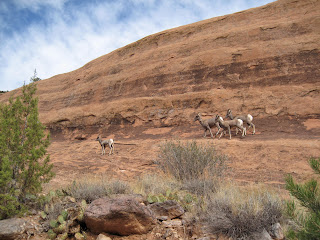 Monument Canyon offers a variety of hiking options, all stemming from the Monument Canyon trail. This 5.2 mile route gains almost 1,500’ of elevation as it winds along the broad shoulder of Monument Canyon. At various locations along its length it offers access to many side adventures, including Independence Monument, Wedding Canyon, numerous sport-climbing routes, and other features. While hiking in Monument Canyon, please try to stay on the trail. For all its ruggedness, the desert is a remarkably fragile environment.
The main trail is one of the more popular routes in the Monument. The trail contours along the western cliffs of Monument Canyon. The usually dry creekbed is almost always far below and away from you. The trail can be accessed from either the upper trailhead off Rim Drive or from the Lower Trailhead off Highway 340. The lower trailhead is popular for casual day hikers and is also the normal approach to Independence Monument and the climbs of the lower canyon. A fun day trip is to start at the upper trailhead and hike through to the bottom with a vehicle shuttle.
From the lower trailhead, it is 1 mile to the first climbing wall where the popular First Dihedral route is located. The second main wall comes around 1.3 or so and Independence Monument is at mile 2.3.
CLIMBING
 Monument Canyon offers some of the best climbing in the Grand Junction area. Everything from tall, multi-pitch desert towers to technical sport climbs are available. There are some serious classics in Monument Canyon. Otto's Route on Independence Monument is the most obvious example but other routes such as First Dihedral, Get a Life, Desert Solitaire,and others are also excellent quality. The nearby Kissing Couple and Sentinel Spire also provide excellent, challenging and adventurous tower climbing.
Here are just a few of the routes in the Monument Canyon area:
Trad
Tower (by easiest route):

Independence Monument (4 pitches, 5.8+, Grade III)
Kissing Couple (5 pitches 5.11a, Grade III)
Pipe Organ (5 pitches 5.11+)
Sentinel Spire (3 pitches 5.10)
Get a Life (Clueless Tower) (5 pitches, 5.12c, Grade III)
Wall:
 Left Dihedral (2 pitches, 5.12- or 5.8+ for first pitch only)
Right Dihedral (1 pitch; 5.9)
Out of the Fryingpan (1 pitch, 5.9)
Route 2 (1 pitch, 5.9)
Route 4 (1 pitch, 5.9+)
Desert Solitaire (6 pitches, 5.11a A1, Grade III)
Sport
Circle, Square, and the Triangle (5.10a)
Wingate Warrior (5.11a)
Higher Mind Dynamics (5.11)
Friends Cant Be Trusted (5.12b)
(note: there is a bolting ban in the Monument. For full climbing regulations please check this link to the National Park Service website.)
A topo of the main wall in Lower Monument Canyon:
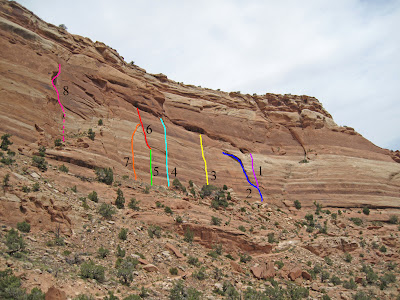
The routes in this photo:
1- Circle, Square, and the Triangle [Sport, 100 feet, 5.10a] **
2- Luhr's Route aka Right Dihedral [Trad, 90 feet, 5.8+] **
3- Higher Mind Dynamics [Sport, 100 feet, 5.11] *
4- Friends Can't Be Trusted [Sport, 110 feet, 5.12b] **
5- First Dihedral aka Left Dihedral (first pitch) [Trad, 50 feet, 5.8+] ***
6- First Dihedral aka Left Dihedral (second pitch) [Trad/aid, 70 feet, 5.10+ C2 or 5.12a] **
7- Carter Route [Trad, 100 feet, 5.9] *
8- Euro Route [Trad, 100 feet, 5.11 (class 4 scramble just to get to base)]*
other photos:
This is only a small sample of the climbing in the area and there is likely still potential for development in the Canyon's hidden corners (which are numerous). This place is vast; the more effort you are willing to put in the more you are going to get out. For a deeper discussion of the trad and sport climbing in Monument Canyon check out the Mountain Project link in the external links section.
SPECIAL CONSIDERATIONS
Monument Canyon is within the borders of the Colorado National Monument. Check with the National Park Service for special regulations One important rule for climbers is that bolting is no longer allowed within that canyon except to replace old dangerous hardware. The addition of new bolts is forbidden. Season raptor closures also affect several walls. Check with the National Park Service to find out when they are in effect.
TRIP REPORTS
Following in the Chipped Footsteps of a Pioneer
Is Otto's Route on Independence Monument a mega classic or chipped abomination? Explore this great route and the history of its creator.
What Does Independence Mean to You?- A weekend climbing in Unaweep and the Colorado National Monument, including a day at the Lower Monument Canyon slabs and an ascent of Otto's Route on Independence Tower.
Visit THE ARCHIVE: A list of most of our articles sorted by department
Copyright notice: This website and all its contents are the intellectual property of www.coloradomountaineering.com and its authors. None of the content can be used or reproduced without the approval of www.coloradomountaineering.com.
Climbing and mountaineering are dangerous!! Please see the DISCLAIMER page
For information about how to contact us, visit this link
 |
| approaching Independence Tower in Monument Canyon |
GETTING THERE
Upper Monument Canyon Trailhead: on Rim Rock Road in the Colorado National Monument, 8.1 miles from the park's west entrance.
Lower Monument Canyon Trailhead: Follow Grand Avenue from downtown Grand Junction west where it turns into Broadway and crosses the Colorado River. Continue on this road 8 miles through a neighbrhood and past many intersections (the road becomes Highway 340) until you reach a small dirt road marked with a sign for Lower Monument Canyon. This turnoff is notoriously easy to miss so be alert. There is a small parking lot here at this popular trailhead.
HISTORY

The route Otto established on Independence Monument is still the easiest and standard route today. Named after its developer, Otto's Route is a four-pitch, 5.8+ Grade III. It is one of Colorado's few notable sandstone towers.
HIKING

The main trail is one of the more popular routes in the Monument. The trail contours along the western cliffs of Monument Canyon. The usually dry creekbed is almost always far below and away from you. The trail can be accessed from either the upper trailhead off Rim Drive or from the Lower Trailhead off Highway 340. The lower trailhead is popular for casual day hikers and is also the normal approach to Independence Monument and the climbs of the lower canyon. A fun day trip is to start at the upper trailhead and hike through to the bottom with a vehicle shuttle.
From the lower trailhead, it is 1 mile to the first climbing wall where the popular First Dihedral route is located. The second main wall comes around 1.3 or so and Independence Monument is at mile 2.3.
CLIMBING
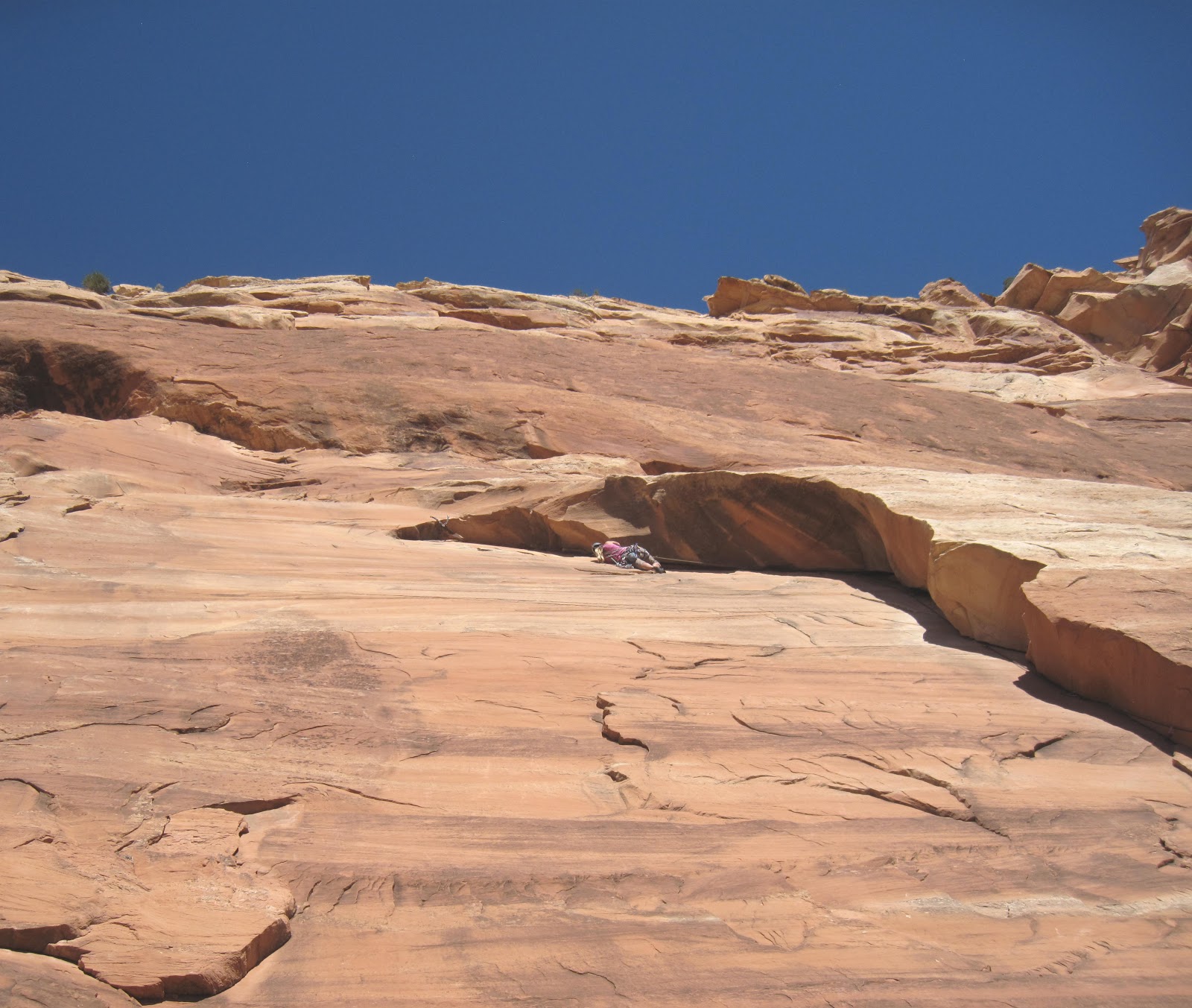
Here are just a few of the routes in the Monument Canyon area:
Trad
Tower (by easiest route):

Independence Monument (4 pitches, 5.8+, Grade III)
Kissing Couple (5 pitches 5.11a, Grade III)
Pipe Organ (5 pitches 5.11+)
Sentinel Spire (3 pitches 5.10)
Get a Life (Clueless Tower) (5 pitches, 5.12c, Grade III)
Wall:

Right Dihedral (1 pitch; 5.9)
Out of the Fryingpan (1 pitch, 5.9)
Route 2 (1 pitch, 5.9)
Route 4 (1 pitch, 5.9+)
Desert Solitaire (6 pitches, 5.11a A1, Grade III)
Sport
Circle, Square, and the Triangle (5.10a)
Wingate Warrior (5.11a)
Higher Mind Dynamics (5.11)
Friends Cant Be Trusted (5.12b)
(note: there is a bolting ban in the Monument. For full climbing regulations please check this link to the National Park Service website.)
A topo of the main wall in Lower Monument Canyon:

The routes in this photo:
1- Circle, Square, and the Triangle [Sport, 100 feet, 5.10a] **
2- Luhr's Route aka Right Dihedral [Trad, 90 feet, 5.8+] **
3- Higher Mind Dynamics [Sport, 100 feet, 5.11] *
4- Friends Can't Be Trusted [Sport, 110 feet, 5.12b] **
5- First Dihedral aka Left Dihedral (first pitch) [Trad, 50 feet, 5.8+] ***
6- First Dihedral aka Left Dihedral (second pitch) [Trad/aid, 70 feet, 5.10+ C2 or 5.12a] **
7- Carter Route [Trad, 100 feet, 5.9] *
8- Euro Route [Trad, 100 feet, 5.11 (class 4 scramble just to get to base)]*
other photos:
|  |
 |  |
 |  |
This is only a small sample of the climbing in the area and there is likely still potential for development in the Canyon's hidden corners (which are numerous). This place is vast; the more effort you are willing to put in the more you are going to get out. For a deeper discussion of the trad and sport climbing in Monument Canyon check out the Mountain Project link in the external links section.
SPECIAL CONSIDERATIONS
Monument Canyon is within the borders of the Colorado National Monument. Check with the National Park Service for special regulations One important rule for climbers is that bolting is no longer allowed within that canyon except to replace old dangerous hardware. The addition of new bolts is forbidden. Season raptor closures also affect several walls. Check with the National Park Service to find out when they are in effect.
TRIP REPORTS
Following in the Chipped Footsteps of a Pioneer
Is Otto's Route on Independence Monument a mega classic or chipped abomination? Explore this great route and the history of its creator.
What Does Independence Mean to You?- A weekend climbing in Unaweep and the Colorado National Monument, including a day at the Lower Monument Canyon slabs and an ascent of Otto's Route on Independence Tower.
Visit THE ARCHIVE: A list of most of our articles sorted by department
Friday, December 21, 2012
AREA PROFILE: Glenwood Canyon
INTRODUCTION
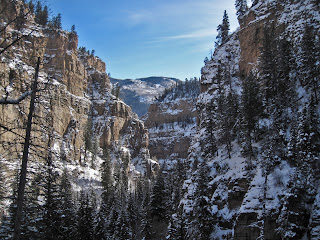 Glenwood Canyon is a major canyon along the Colorado River in the heart of the Rocky Mountains. It is a recreational hub for biking, hiking, riversports, spelunking and climbing as well as a major travel artery for Colorado and the west. The Cambrian and sedimentary rocks soar 2,000 feet above the river, providing dramatic scenery and unique geologic architecture. The canyon's limestone is home to many caves and other dramatic formations. Glenwood Canyon is an important travel corridor and during its history has been home to a railway, a bike path, a two-lane highway, and now a four-lane interstate which was completed in 1992. The Shoshone Dam and Powerplant, operated by Excel and located immediately downstream of the Hanging Lake recreation area, was completed in 1909 and utilizes hydroelectric energy to provide power to nearly 12,000 homes in the Glenwood Springs area.
From a climbing and hiking perspective, Glenwood Canyon is host to innumerable opportunities for recreation and exploration. Glenwood Canyon is in the White River National Forest and several of the trails can access, with a little proper preparation and know-how, the Flat Tops Wilderness Area. Several of the canyon's walls have been developed with both sport and trad routes, the most popular being No Name for traditional climbing and the Puoux for sport. Other types of climbing exist, however, including grade IV routes on the International Buttress in the heart of the canyon and Grizzly Creek Canyon's Mudwall as well as ice climbing in various locations. Glenwood Canyon is not only popular with hikers and climbers but with rafters, bikers, kayakers, inner-tubers, I-70 truckers, roller-skaters, sun bathers, and folk of all other sort. Most seem to coexist peacefully despite a premium on parking.
HISTORY
Glenwood Canyon has a unique and storied history. In the late 19th century the Denver and Rio Grande Western Railroad completed its tracks through the canyon, providing the first travel route through the canyon corridor. These tracks are owned and operated today by Union Pacific and are frequently used for coal transportation and by Amtrak. In 1906 the Taylor State Road was completed through the canyon. This highway was eventually paved. In 1992 the construction of I-70 was completed through the canyon. This section of I-70 was one of the last pieces of I-70 to be completed and, at the time, was the most expensive section of road in the interstate-highway system. Great care was taken during the construction of the I-70 project to preserve the canyon’s natural beauty and minimize the environmental impact. The project included 40 bridges and viaducts, miles of retaining walls, and three major tunnels. The entire system also includes considerable technology for monitoring and controlling traffic, accidents, and rockfall along this section of the interstate.
Glenwood Canyon also is home to the Shoshone Dam and Powerplant. When this project was completed in 1909 it made Glenwood Springs one of the first fully-powered cities in the United States.
Glenwood Canyon is also home to several major hot springs, many of which can be enjoyed for free at river level during low water. The Yampah spring is the largest and is the source for the ultra-popular Hot Springs Pool in Glenwood Springs. Old West gunslinger Doc Holliday died in Glenwood Springs where he came to find some relief for his tuberculosis in the Yampah spring.
Teddy Roosevelt frequented the Hotel Colorado at the mouth of the canyon many times during his life. Supposedly, one day after a failed bear hunt Hotel Colorado maids presented him with a stuffed bear made of scrap material as a consolation for failing to bag the real thing. As legend would have it, Teddy Roosevelt presented the bear to his daughter, the idea caught on, and the toy now known as the teddy bear was born. Teddy Roosevelt, interestingly, wasn't the only celebrity who frequented the Hotel Colorado. It was a mountain retreat for many of America's elite of the time. President William Howard Taft, The "Unsinkable" Molly Brown, "Diamond" Jack Alterie, and even Al Capone made frequent trips to the hotel. The building has such a storied (and even violent) history that it is rumored to be haunted. Almost every Glenwood Springs local either has or knows someone who has a Hotel Colorado ghost story.
HIKING
There are numerous quality hikes in Glenwood Canyon, many of which offer exciting potential for more in-depth exploration. The Glenwood Canyon Bike Path is a concrete trail that follows the river for the entire length of the canyon from near Dotsero to Glenwood Springs. This 18-mile trail is popular for joggers, bikers, and casual hikers.
The Grizzly Creek trail is an 8-mile trek (roundtrip) up a wide and rugged canyon along a perennial creek that provides the water supply for the City of Glenwood Springs. This popular trail is used by hikers of all abilities, from restless I-70 drivers shaking their legs after a long driving shift to casual hikers who rarely go past the first mile to full-on adventurers who continue well-past the seeming "end" of the trail, perhaps all the way into the Flat Tops Wilderness Area.
The Jess Weaver trail follows No Name Canyon, the next drainage west of Grizzly Creek. No Name also offers miles of hiking in a beautiful canyon setting.
The most popular trail, however, is the Hanging Lake trail which climbs 1,200 strenuous feet to a verdant oasis of waterfalls and lakes. Surely this is one of the most popular hiking trails in this part of the state and for good reason. While Hanging Lake can be very busy during the summer, especially on weekends, solitude can still be found in the off-season. Fall is one of the best times to visit the canyon. The combination of colors in the beautiful lake setting is breathtaking. Wintertime can be treacherous, as dangerous ice can form in the canyon. For those with knowledge of ice travel and ice climbing the trip can be very rewarding.
ROCK CLIMBING
Glenwood Canyon has several quality climbing areas that offer a variety of climbing adventures. The rock in Glenwood Canyon is a mixture of limestone, quartzite, and granite of mixed quality. In the 1960's and 70's, legendary Colorado climber and occasional Glenwood local Layton Kor spent much time training on the rock in Glenwood Canyon for more heralded first ascents across the Southwest, such as mega-classics the Naked Edge (III 5.9 A3) in Eldorado Canyon, The Yellow Wall (V 5.8 A4) on the Diamond on Longs Peak, the West Buttress (VI 5.10 A3) on El Cap, and the Kor-Ingalls (III 5.9+) route on Castleton Tower just to name a few. Relics of Kor's extensive exploration of the walls of Glenwood Canyon can be found in surprising places, from random pitons on the Puoux to established routes on the Mudwall to unknown random gear on many of the canyon's most obscure walls. It has been a common experience of modern Glenwood Canyon climbing pioneers to be climbing up dirty towers and faces, thinking they were establishing a brand new route only to find pitons and anchors likely placed there by Kor.
Despite this history and the immense wealth of large walls in the Canyon, it is a relatively untapped and under-appreciated climbing destination. There are several contributing factors to the obscurity of Glenwood Canyon's climbing. One is the presence of I-70. At crags like the Airy Block and the Puoux, the noise of numerous semis, cars, and SUVs is certainly enough to damper your experience. I-70 also takes up alot of space and limits the portals of access, making the approach to many walls quite a task, particularly those that are located on the opposite side of the river. The other deterring factor is the large band of loose, blocky quartzite that dominates much of the canyon terrain. While this large layer has yielded some interesting climbs and crags such as the Mudwall and the Deadhorse wall, its gnarly character eliminate all but hardened adventure climbers. Still, there are at least half a dozen established crags of both traditional and sport climbing, and there is amazing potential for expansion if you are willing to put in a little work. Here is a list of the most-popular Glenwood Canyon climbing destinations:
The Puoux- a limestone sport crag near the No Name exit. The Puoux (pronounced “Pukes”) offers easily accessible sport climbing immediately off of I-70 with difficulty ranging from 5.7 to 5.14. This fairly popular spot keeps the locals in shape. Some of the established sport lines include:


No Name Canyon- located just off the Jess Weaver trail, this area has several single-pitch trad climbing routes from 5.4 to 5.12. Here are some of the No Name favorites:


The Neighborhood- a sport crag near the canyon mouth just east of Glenwood Springs on the south side of the river. This little spot is easily accessible for Glenwood locals as an afterwork/school climb. The lines rate from 5.9 to 5.12b
Big (or almost big) Wall:


A non-exhaustive list of some of the other, less-traveled climbing crags in Glenwood Canyon:
The Airy Block- an interesting fin of granite with several good moderate trad climbs. The only catch is it's right next to the freeway...
Dead Horse Crag- this quartzite crag is accessed off the trail to Hanging Lake. There are several climbs of surprising quality from 5.9 to hard 5.11. Most require some gear to supplement bolts.
Fountain Buttress- Some of the best rock in the canyon, but difficult to access due to a river crossing. A tyrolean is sometimes set-up here, otherwise you will have to use a boat, swim or wait until very low water and walk across. Despite the excellent rock, classic routes, and massive potential, this rock sees surprisingly little use.
The Grey Slabs- Slabby, limestone climbing on the canyon's western end. Access by parking near the Hot Springs or Vapor Caves and hiking upstream along the bike path. Good moderate sport routes.
The Surgery Buttress- This limestone crag on the canyon's eastern end is also under-appreciated. There are about 15 climbs here from 5.9 to 5.12a.
OTHER RECREATIONAL ACTIVITIES
Biking- The Glenwood Canyon Bike Path offers 18 miles of uninterrupted concrete pathway through a beautiful canyon setting. This trail is mellow and popular and provides a nice opportunity for a good workout/escape.
Spelunking-The limestone of Glenwood Canyon has formed many caves, some of which have been explored and some of which have not. The Glenwood Caverns, high on the northern side of the canyon near Glenwood, offers established cave tours in a family-oriented amusement park setting. Undeveloped caves such as Cave of the Clouds offer something for those with a sense of adventure looking for something off-the-beaten-path.
River Sports- River sports are one of the most popular recreational activities in Glenwood Canyon. There are many options for kayaking and rafting within the canyon ranging from beginner to expert only. Local commercial outfitters run half & full day raft trips down the Colorado River through Glenwood Canyon. This is also an excellent place to learn and hone your kayaking skills. The runs include (from top to bottom):
SEASON
Recreation is available in Glenwood Canyon year round. In the summer the canyon is busy with people pursuing adventures of all sorts. In the winter, however, the narrow canyon is mostly shaded and cold but you can still hike and climb. There is, in fact, a long-running tradition amongst kayakers to float the Shoshone section of the Colorado River on New Year’s Day.


GETTING THERE
Glenwood Canyon is accessible from I-70 just east of Glenwood Springs. There are several exits from the freeway from which to launch your adventure, the most popular are No Name (exit 119), Grizzly Creek (exit 121), and Hanging Lake (exit 125).
CAMPING
The only legal place to camp inside Glenwood Canyon is at the developed Glenwood Canyon Resort at the No Name exit. The resort offers cabins, showers, rec rooms, and tent sites.
EXTERNAL LINKS
Mountain Project climbing pages:
Puoux
No Name Canyon
The Neighborhood
Glenwood Hot Springs- The World's Largest Hot Springs Pool.
Copyright notice: This website and all its contents are the intellectual property of www.coloradomountaineering.com and its authors. None of the content can be used or reproduced without the approval of www.coloradomountaineering.com.
Climbing and mountaineering are dangerous!! Please see the DISCLAIMER page
For information about how to contact us, visit this link

From a climbing and hiking perspective, Glenwood Canyon is host to innumerable opportunities for recreation and exploration. Glenwood Canyon is in the White River National Forest and several of the trails can access, with a little proper preparation and know-how, the Flat Tops Wilderness Area. Several of the canyon's walls have been developed with both sport and trad routes, the most popular being No Name for traditional climbing and the Puoux for sport. Other types of climbing exist, however, including grade IV routes on the International Buttress in the heart of the canyon and Grizzly Creek Canyon's Mudwall as well as ice climbing in various locations. Glenwood Canyon is not only popular with hikers and climbers but with rafters, bikers, kayakers, inner-tubers, I-70 truckers, roller-skaters, sun bathers, and folk of all other sort. Most seem to coexist peacefully despite a premium on parking.
HISTORY
 |
| Record high water in Glenwood Canyon- June 2011 |
Glenwood Canyon also is home to the Shoshone Dam and Powerplant. When this project was completed in 1909 it made Glenwood Springs one of the first fully-powered cities in the United States.
Glenwood Canyon is also home to several major hot springs, many of which can be enjoyed for free at river level during low water. The Yampah spring is the largest and is the source for the ultra-popular Hot Springs Pool in Glenwood Springs. Old West gunslinger Doc Holliday died in Glenwood Springs where he came to find some relief for his tuberculosis in the Yampah spring.
Teddy Roosevelt frequented the Hotel Colorado at the mouth of the canyon many times during his life. Supposedly, one day after a failed bear hunt Hotel Colorado maids presented him with a stuffed bear made of scrap material as a consolation for failing to bag the real thing. As legend would have it, Teddy Roosevelt presented the bear to his daughter, the idea caught on, and the toy now known as the teddy bear was born. Teddy Roosevelt, interestingly, wasn't the only celebrity who frequented the Hotel Colorado. It was a mountain retreat for many of America's elite of the time. President William Howard Taft, The "Unsinkable" Molly Brown, "Diamond" Jack Alterie, and even Al Capone made frequent trips to the hotel. The building has such a storied (and even violent) history that it is rumored to be haunted. Almost every Glenwood Springs local either has or knows someone who has a Hotel Colorado ghost story.
HIKING
There are numerous quality hikes in Glenwood Canyon, many of which offer exciting potential for more in-depth exploration. The Glenwood Canyon Bike Path is a concrete trail that follows the river for the entire length of the canyon from near Dotsero to Glenwood Springs. This 18-mile trail is popular for joggers, bikers, and casual hikers.
 |
| Scenery along the Grizzly Creek Trail |
The Jess Weaver trail follows No Name Canyon, the next drainage west of Grizzly Creek. No Name also offers miles of hiking in a beautiful canyon setting.
The most popular trail, however, is the Hanging Lake trail which climbs 1,200 strenuous feet to a verdant oasis of waterfalls and lakes. Surely this is one of the most popular hiking trails in this part of the state and for good reason. While Hanging Lake can be very busy during the summer, especially on weekends, solitude can still be found in the off-season. Fall is one of the best times to visit the canyon. The combination of colors in the beautiful lake setting is breathtaking. Wintertime can be treacherous, as dangerous ice can form in the canyon. For those with knowledge of ice travel and ice climbing the trip can be very rewarding.
ROCK CLIMBING
Glenwood Canyon has several quality climbing areas that offer a variety of climbing adventures. The rock in Glenwood Canyon is a mixture of limestone, quartzite, and granite of mixed quality. In the 1960's and 70's, legendary Colorado climber and occasional Glenwood local Layton Kor spent much time training on the rock in Glenwood Canyon for more heralded first ascents across the Southwest, such as mega-classics the Naked Edge (III 5.9 A3) in Eldorado Canyon, The Yellow Wall (V 5.8 A4) on the Diamond on Longs Peak, the West Buttress (VI 5.10 A3) on El Cap, and the Kor-Ingalls (III 5.9+) route on Castleton Tower just to name a few. Relics of Kor's extensive exploration of the walls of Glenwood Canyon can be found in surprising places, from random pitons on the Puoux to established routes on the Mudwall to unknown random gear on many of the canyon's most obscure walls. It has been a common experience of modern Glenwood Canyon climbing pioneers to be climbing up dirty towers and faces, thinking they were establishing a brand new route only to find pitons and anchors likely placed there by Kor.
 |
| Ironing Board Direct (5.10b) in No Name Canyon |
Despite this history and the immense wealth of large walls in the Canyon, it is a relatively untapped and under-appreciated climbing destination. There are several contributing factors to the obscurity of Glenwood Canyon's climbing. One is the presence of I-70. At crags like the Airy Block and the Puoux, the noise of numerous semis, cars, and SUVs is certainly enough to damper your experience. I-70 also takes up alot of space and limits the portals of access, making the approach to many walls quite a task, particularly those that are located on the opposite side of the river. The other deterring factor is the large band of loose, blocky quartzite that dominates much of the canyon terrain. While this large layer has yielded some interesting climbs and crags such as the Mudwall and the Deadhorse wall, its gnarly character eliminate all but hardened adventure climbers. Still, there are at least half a dozen established crags of both traditional and sport climbing, and there is amazing potential for expansion if you are willing to put in a little work. Here is a list of the most-popular Glenwood Canyon climbing destinations:
The Puoux- a limestone sport crag near the No Name exit. The Puoux (pronounced “Pukes”) offers easily accessible sport climbing immediately off of I-70 with difficulty ranging from 5.7 to 5.14. This fairly popular spot keeps the locals in shape. Some of the established sport lines include:
| Route | Type | Pitches | Difficulty | Location/Description |
|---|---|---|---|---|
| No Name 1 (aka Graybeard) | Sport | 1 | 5.8 | This excellent pitch is one of the better moderate routes at the wall |
| Pass the Ditchie | Sport | 1 | 5.9 | Scramble up to a ledge and climb an arcing dihedral past a piton to the anchors. Fun! |
| No Name 5 (Roadside Attraction) | Sport | 1 | 5.10a | Polished and popular. This is probably the most frequently climbed pitch in the canyon |
| No Name 4 (aka Moral Decay) | Sport | 1 | 5.10a | Another good moderate route on solid rock. 60 ft up a slab then onto a flake |
| Youth Warm Up | Sport | 1 | 5.11c | On the left side of the Main Wall at the Puoux. Challenging and popular route. |
| No Name 18 (aka Kors Korner) | Sport | 1 | 5.11d | A challenging route in the middle of the main wall. |
| Urban Cowboy | Sport | 1 | 5.12a | One of the best 5.12s around. Steep, perfectly bolted. Does have some manufactured holds. |
| The Birdman | Sport | 1 | 5.13a | A 55 ft route on the left side of the main wall. Part of recent development at the upper grades |
| Fault Line | Sport | 1 | 5.13d | A local test piece! A photo of Joe Kinder on this difficult route accelerated the popularity of the Puoux |


No Name Canyon- located just off the Jess Weaver trail, this area has several single-pitch trad climbing routes from 5.4 to 5.12. Here are some of the No Name favorites:
| Route | Type | Pitches | Difficulty | Location/Description |
|---|---|---|---|---|
| Second Dihedral | trad | 1 | 5.6 | A high-quality corner, just to the right of the Pink Face. Perfect first lead. |
| Jungle Book | trad | 1 | 5.7 | An open corner just to the right of Unnamed aka "The Ironing Board" (5.9) |
| Electric Butterfly | trad | 1 | 5.8 | A fun, moderate climb next to the power shack just before the footbridge over No Name Creek. Can be done as TR |
| The Ironing Board | trad | 1 | 5.9 | A right-trending splitter with challenging gear placements and a 5.10b direct variation |
| The Pink Face | trad | 1 | 5.10+ | A long (110') splitter just left of Second Dihedral. |
| Lone Pine Direct | trad | 1 | 5.10 | Down and left from the Pink Face heading towards a pine tree. Thin splitter with finger to hand sized moves |
| Lightning Bolt Crack | trad | 1 | 5.10 | West side of creek on the Poison Ivy Wall. |
| Lost Dog | trad | 1 | 5.12- | A recently posted route that comes right out of the creek. Three bolts in addition to finger sized gear. Possible #3 Camalot sized piece |


The Neighborhood- a sport crag near the canyon mouth just east of Glenwood Springs on the south side of the river. This little spot is easily accessible for Glenwood locals as an afterwork/school climb. The lines rate from 5.9 to 5.12b
| Route | Type | Pitches | Difficulty | Location/Description |
|---|---|---|---|---|
| Planet Janet | sport | 1 | 5.9+ | On the far right side of the Zipper Buttress. Short climb that follows a unique "groove". |
| California Dreaming | sport | 1 | 5.9+ | Right-facing dihedral 20 feet left of where trail meets crag. |
| Git 'Er Done | sport | 1 | 5.10c | Right side of Zipper Buttress starting in a chimney. |
| Zipper | sport | 1 | 5.11c | A 7-bolt climb sometimes called the best 5.11 in Glenwood Canyon |
| Enter the Dragon | sport | 1 | 5.12a | The feature route on the Dragon Cave wall and one of the best 5.12's in the canyon. |
| Bitch Slap | sport | 1 | 5.12b | Shares first bolts with The Tube but veers left. |
Big (or almost big) Wall:
| Route | Type | Pitches | Difficulty | Location/Description |
|---|---|---|---|---|
| The International | trad | 18 | 5.10+, Grade IV | A massive Grad IV climb in-between the Shoshone and Hanging Lake exits on south bank of river |
| Mudflap Girl | trad | 10 | 5.10, Grade IV | A monster, chossy wall about a mile up Grizzly creek on the west side of canyon. Can be seen from I-70 |


A non-exhaustive list of some of the other, less-traveled climbing crags in Glenwood Canyon:
The Airy Block- an interesting fin of granite with several good moderate trad climbs. The only catch is it's right next to the freeway...
Dead Horse Crag- this quartzite crag is accessed off the trail to Hanging Lake. There are several climbs of surprising quality from 5.9 to hard 5.11. Most require some gear to supplement bolts.
Fountain Buttress- Some of the best rock in the canyon, but difficult to access due to a river crossing. A tyrolean is sometimes set-up here, otherwise you will have to use a boat, swim or wait until very low water and walk across. Despite the excellent rock, classic routes, and massive potential, this rock sees surprisingly little use.
The Grey Slabs- Slabby, limestone climbing on the canyon's western end. Access by parking near the Hot Springs or Vapor Caves and hiking upstream along the bike path. Good moderate sport routes.
The Surgery Buttress- This limestone crag on the canyon's eastern end is also under-appreciated. There are about 15 climbs here from 5.9 to 5.12a.
OTHER RECREATIONAL ACTIVITIES
Biking- The Glenwood Canyon Bike Path offers 18 miles of uninterrupted concrete pathway through a beautiful canyon setting. This trail is mellow and popular and provides a nice opportunity for a good workout/escape.
 |
| Rafters in Glenwood Canyon |
River Sports- River sports are one of the most popular recreational activities in Glenwood Canyon. There are many options for kayaking and rafting within the canyon ranging from beginner to expert only. Local commercial outfitters run half & full day raft trips down the Colorado River through Glenwood Canyon. This is also an excellent place to learn and hone your kayaking skills. The runs include (from top to bottom):
| Section | Put-in | Take-out | Length | <2,000cfs (low) | 2,000-5,000 cfs (medium) | 5,000-10,000 cfs (high) | >10,000 cfs (cranking) |
|---|---|---|---|---|---|---|---|
| Dotsero-Bair Ranch | Bike Path east trailhead | Bair Ranch | 3 miles | class I+ | class I+ | class I + | class II |
| Barrel Springs | Hanging Lake | Shoshone Power Plant | 2 miles | class IV+ (P) | class V (P) | class V (P) | class V+ (P) |
| Shoshone | Shoshone Power Plant | Grizzly Creek | 2 miles | class III | class III | class IV | class IV+ |
| Grizzly | Grizzly Creek | Two Rivers Park | 6 miles | class II | class II+ | class III | class III |
SEASON
Recreation is available in Glenwood Canyon year round. In the summer the canyon is busy with people pursuing adventures of all sorts. In the winter, however, the narrow canyon is mostly shaded and cold but you can still hike and climb. There is, in fact, a long-running tradition amongst kayakers to float the Shoshone section of the Colorado River on New Year’s Day.


Glenwood Canyon is accessible from I-70 just east of Glenwood Springs. There are several exits from the freeway from which to launch your adventure, the most popular are No Name (exit 119), Grizzly Creek (exit 121), and Hanging Lake (exit 125).
CAMPING
The only legal place to camp inside Glenwood Canyon is at the developed Glenwood Canyon Resort at the No Name exit. The resort offers cabins, showers, rec rooms, and tent sites.
EXTERNAL LINKS
Mountain Project climbing pages:
Puoux
No Name Canyon
The Neighborhood
Glenwood Hot Springs- The World's Largest Hot Springs Pool.
Sunday, December 16, 2012
NEWS: 11-Year-Olds Making Climbing Headlines
Although it does not directly pertain to Colorado, this astounding news is relevant to all in the climbing community and thus worth reporting here. 11-year-old Mirko Caballero sent classic 5.14a Ubermensch in California just a few days ago, according to Rock and Ice Magazine and Caballero's 8a.nu scorecard. This classic route was originally put up by Chris Sharma.
Caballero isn't the only 11 year old making headlines. Climbing phenom Ashima Shiraishi from New York redpointed Lucifer and Southern Smoke, both rated 5.14c, at Red River Gorge and flashed Omaha Beach (5.14a). She was the youngest person, male or female, to both flash a 5.14a and redpoint a 5.14c.
Below is a video of Ashima climbing, including her ascent of V13 Crown of Aragorn in Hueco Tanks, TX:
Visit THE ARCHIVE: A list of most of our articles sorted by department
Copyright notice: This website and all its contents are the intellectual property of www.coloradomountaineering.com and its authors. None of the content can be used or reproduced without the approval of www.coloradomountaineering.com.
Climbing and mountaineering are dangerous!! Please see the DISCLAIMER page
For information about how to contact us, visit this link
Caballero isn't the only 11 year old making headlines. Climbing phenom Ashima Shiraishi from New York redpointed Lucifer and Southern Smoke, both rated 5.14c, at Red River Gorge and flashed Omaha Beach (5.14a). She was the youngest person, male or female, to both flash a 5.14a and redpoint a 5.14c.
Below is a video of Ashima climbing, including her ascent of V13 Crown of Aragorn in Hueco Tanks, TX:
Wednesday, August 22, 2012
Single Hardest Move vs. Route as a Whole: The Great Ratings Debate
INTRODUCTION
I was a paddler long before I was a climber, so I am used to the idea of rating difficulty in terms of the total problem not the single hardest move. In whitewater, when grading the difficulty of a rapid you factor in everything from technical difficulty to length and consequences. A very short rapid with a large, safe pool at the bottom would get a lower rating then a rapid that was just as difficult but is backed up by a long, dangerous runout. A long series of moves at the same difficulty would get a higher rating than any of individual moves on their own.
I became a rock climber through mountaineering. It started with an ascent of our local mountain Mt. Sopris (12,953’). Needless to say that after that first, fateful climb an addiction to the high country ensued and I found myself spending nearly all of my free time researching and climbing as many mountains as I could. Time that would have been better spent studying for finals and writing papers was instead spent studying topos and researching mountaineering history. I climbed many easy (class 2 or lower) Colorado peaks and tiptoed into class 3 with routes such as East Slopes of Snowmass Mountain, and the Sawtooth. Soon I was drawn into the class 4 mountains and, feeling strong, I couldn’t help but dream of what lie beyond.
Arriving at Longs Peak near the end of a twenty-fourteener summer to attempt the Keyhole Route, I couldn’t help but look at the amazing cliffs and bastions of the north and east faces and dream of ascending it by a technical route. Kiener’s route on Longs Peak beckoned to me with a siren call. I had to learn technical climbing skills so I could climb these high peaks.
Today I have become just as addicted to rock climbing as its own pursuit as I am with mountaineering and alpine. I will always be a climber with a lust for something bigger than the crag, but I also love the relaxing simplicity of cragging at any of the climbing walls near my home in Glenwood Springs, Colorado.
THE RATING GAME
One of the things that fascinates me about both rock and mountain climbing is grading terrain. At once rating terrain is both amazingly subjective and intricately precise. How can it be both of these things?
In the United States we are stuck, for better or worse, with the Yosemite Decimal System. It might be useful to review a little YDS history. The YDS system started when the Sierra Club needed a way to grade various hikes and climbs in the Sierra Nevadas. They created five “classes” from class 1 (trail walking) to class 5 (technical rock climbing). A few years later, climbers at Tahquitz Rock found it necessary to subdivide the 5th class grade which encompassed a very large range of possible difficulty. The climbers of the era devised a decimal-based scale that went from 5.0 to 5.9. To abridge a very long saga, as climbers advanced and technology increased there came a need to open the scale. As of now the scale has been pushed to 5.15b. Only an elite and highly exclusive group of climbers have ever climbed at this level.
But what about those ratings? How do we define them? The challenges in creating a rating system for something as complex as rock difficulty are so numerous that at times the whole endeavor seems ridiculous. On the other hand, while you encounter discrepancies, regional interpretations, differences in rock type, differences in climbing discipline, the YDS has proven to be useful not only as a guide for us to climbs that properly challenge our abilities but also as a tool for measuring our own improvement as well as for comparing ourselves against others.
In a previous article, I attempted to broadly define the various levels of the YDS system. All sorts of interesting feedback, both positive and negative, flooded in in response. In this article I seek not to share my own opinion about a single, specific YDS topic, but to explore two different schools of thought when grading rock and terrain.
THE DEBATE
 I originally learned the YDS under the impression that the system rated the technical difficulty of the single hardest move. I found this method faulty, because although two routes might be the same in technical difficulty one inevitably be harder for any number of various reasons (i.e. it is much longer). On the other hand it comes closer to removing subjectivity than the other option, the route as a whole, which somehow has to account not only with a climber’s technical ability but also their physical conditioning.
For years, I believed wholeheartedly that YDS adhered to the single hardest move philosophy. You knew what an .11b move felt like and if you encountered one on any point of a climb than that was what the climb was rated. Even if the entire climb was 5.7 with a single 5.11b move it would be rated 5.11b. If another climb was stacked with hard moves one after the other with no rests but no single move was harder than 5.11b than the climb would also be rated 5.11b. There is the problem with this method. But still, as a climber, I feel better knowing that the climb will never be any harder than 5.11b (my current redpoint limit) and if I cant pull the route it simply means I need to train harder to build endurance for the more sustained 5.11b.
Recently, however, I was discussing ratings with a good friend and a much more experienced climber than myself (he climbed the Diamond at age 16, has bagged numerous big wall routes and committing trad/alpine routes, and currently enjoys redpointing 5.13c in Rifle Mountain Park) talked about how some 5.12a routes in Rifle don’t have any moves harder than 5.11b but are so long and pumpy that they get the 5.12a rating. Clearly this is a route as a whole mentality. In some ways I find this encouraging, because I know I am physically capable of pulling a 5.11b move. In theory, then, if I trained hard enough I should be able to climb this 5.12a. But if I climbed a 5.12a route wouldn’t that mean that I could pull a 5.12a “move”? Or can we not rate the difficulty of a single move? Must we have a series of moves before we are able to generate a rating? The confusion endures….
 I’ve often heard people say things like, “It’s basically a juggy 5.7 to a V2 boulder problem with some more 5.7 above that.” Does this mean that the Sherman V-scale is better for rating a single move? But I have never believed this to be true either, for I have heard some of the best boulderers quoted after applying ratings like V14 or V15 saying “there is no single move harder than V13 but since it is a link-up of so many hard moves, I believe it is V15”. I always believed that the V-scale was designed to look at the boulder problem as a whole and YDS looked at the single hardest move. That same friend led a trad climb of his own at a local crag which he had rated 5.12c. The route was about 30 feet of 5.10c-ish climbing to a crux bulge with easier climbing above that. The crux was only about 3 moves. My friend described it as a V6 boulder problem and claimed to have had a very difficult time rating this climb. He was sure it was V6 but couldn’t for the life of him settle on a YDS equivalent. It was “too hard to rate just a couple of moves” he claimed.
With so many factors when it comes to rating a climb, it is amazing that we can even come to a general consensus at all. Still YDS is not without its uses. Although it seems like there is a huge variation at times in different people’s opinions about the difficulty of a climb, there is also a general consensus on many routes.
CONCLUSION
I have always looked at the rating of a route based on its single hardest move. How positive is the hold? How big of a reach? What positions do you have to put your body in to make it? All of these factors make up the difficulty of any given move. I liked the single hardest move philosophy because in my mind it made it easier to pin down the given technicality of a specific grade and it eliminates a level of subjectivity about physical conditioning. Recently, however, I have been starting to wonder if this idea is erroneous and that the route as a whole is truly the more accurate way to evaluate a route’s difficulty. I hope here now, to get feedback and see what you all think.
Copyright notice: This website and all its contents are the intellectual property of www.coloradomountaineering.com and its authors. None of the content can be used or reproduced without the approval of www.coloradomountaineering.com.
Climbing and mountaineering are dangerous!! Please see the DISCLAIMER page
For information about how to contact us, visit this link
 |  |  |  |
I was a paddler long before I was a climber, so I am used to the idea of rating difficulty in terms of the total problem not the single hardest move. In whitewater, when grading the difficulty of a rapid you factor in everything from technical difficulty to length and consequences. A very short rapid with a large, safe pool at the bottom would get a lower rating then a rapid that was just as difficult but is backed up by a long, dangerous runout. A long series of moves at the same difficulty would get a higher rating than any of individual moves on their own.
I became a rock climber through mountaineering. It started with an ascent of our local mountain Mt. Sopris (12,953’). Needless to say that after that first, fateful climb an addiction to the high country ensued and I found myself spending nearly all of my free time researching and climbing as many mountains as I could. Time that would have been better spent studying for finals and writing papers was instead spent studying topos and researching mountaineering history. I climbed many easy (class 2 or lower) Colorado peaks and tiptoed into class 3 with routes such as East Slopes of Snowmass Mountain, and the Sawtooth. Soon I was drawn into the class 4 mountains and, feeling strong, I couldn’t help but dream of what lie beyond.
Arriving at Longs Peak near the end of a twenty-fourteener summer to attempt the Keyhole Route, I couldn’t help but look at the amazing cliffs and bastions of the north and east faces and dream of ascending it by a technical route. Kiener’s route on Longs Peak beckoned to me with a siren call. I had to learn technical climbing skills so I could climb these high peaks.
Today I have become just as addicted to rock climbing as its own pursuit as I am with mountaineering and alpine. I will always be a climber with a lust for something bigger than the crag, but I also love the relaxing simplicity of cragging at any of the climbing walls near my home in Glenwood Springs, Colorado.
THE RATING GAME
 |
| The Diamond on Longs Peak |
In the United States we are stuck, for better or worse, with the Yosemite Decimal System. It might be useful to review a little YDS history. The YDS system started when the Sierra Club needed a way to grade various hikes and climbs in the Sierra Nevadas. They created five “classes” from class 1 (trail walking) to class 5 (technical rock climbing). A few years later, climbers at Tahquitz Rock found it necessary to subdivide the 5th class grade which encompassed a very large range of possible difficulty. The climbers of the era devised a decimal-based scale that went from 5.0 to 5.9. To abridge a very long saga, as climbers advanced and technology increased there came a need to open the scale. As of now the scale has been pushed to 5.15b. Only an elite and highly exclusive group of climbers have ever climbed at this level.
But what about those ratings? How do we define them? The challenges in creating a rating system for something as complex as rock difficulty are so numerous that at times the whole endeavor seems ridiculous. On the other hand, while you encounter discrepancies, regional interpretations, differences in rock type, differences in climbing discipline, the YDS has proven to be useful not only as a guide for us to climbs that properly challenge our abilities but also as a tool for measuring our own improvement as well as for comparing ourselves against others.
In a previous article, I attempted to broadly define the various levels of the YDS system. All sorts of interesting feedback, both positive and negative, flooded in in response. In this article I seek not to share my own opinion about a single, specific YDS topic, but to explore two different schools of thought when grading rock and terrain.
THE DEBATE
For years, I believed wholeheartedly that YDS adhered to the single hardest move philosophy. You knew what an .11b move felt like and if you encountered one on any point of a climb than that was what the climb was rated. Even if the entire climb was 5.7 with a single 5.11b move it would be rated 5.11b. If another climb was stacked with hard moves one after the other with no rests but no single move was harder than 5.11b than the climb would also be rated 5.11b. There is the problem with this method. But still, as a climber, I feel better knowing that the climb will never be any harder than 5.11b (my current redpoint limit) and if I cant pull the route it simply means I need to train harder to build endurance for the more sustained 5.11b.
Recently, however, I was discussing ratings with a good friend and a much more experienced climber than myself (he climbed the Diamond at age 16, has bagged numerous big wall routes and committing trad/alpine routes, and currently enjoys redpointing 5.13c in Rifle Mountain Park) talked about how some 5.12a routes in Rifle don’t have any moves harder than 5.11b but are so long and pumpy that they get the 5.12a rating. Clearly this is a route as a whole mentality. In some ways I find this encouraging, because I know I am physically capable of pulling a 5.11b move. In theory, then, if I trained hard enough I should be able to climb this 5.12a. But if I climbed a 5.12a route wouldn’t that mean that I could pull a 5.12a “move”? Or can we not rate the difficulty of a single move? Must we have a series of moves before we are able to generate a rating? The confusion endures….

With so many factors when it comes to rating a climb, it is amazing that we can even come to a general consensus at all. Still YDS is not without its uses. Although it seems like there is a huge variation at times in different people’s opinions about the difficulty of a climb, there is also a general consensus on many routes.
CONCLUSION
I have always looked at the rating of a route based on its single hardest move. How positive is the hold? How big of a reach? What positions do you have to put your body in to make it? All of these factors make up the difficulty of any given move. I liked the single hardest move philosophy because in my mind it made it easier to pin down the given technicality of a specific grade and it eliminates a level of subjectivity about physical conditioning. Recently, however, I have been starting to wonder if this idea is erroneous and that the route as a whole is truly the more accurate way to evaluate a route’s difficulty. I hope here now, to get feedback and see what you all think.
For information about how to contact us, visit this link
Subscribe to:
Posts (Atom)