Showing posts with label hiking. Show all posts

Tuesday, October 22, 2013

Hot Route: Mount Massive, East Slopes

Length: 14 miles
Elevation gain: 4,600 feet
difficulty: class 2

OVERVIEW
Mount Massive east slopes
Mount Massive East Slopes
Mount Massive is a mountain that fits its name. It is truly a giant among lesser Colorado peaks. Although there are shorter ways to climb Massive than this standard route, the East Slopes is the easiest path to the summit from a technical standpoint. Almost the entire climb is on a well-traveled trail. The route is long, however, compared to many standard 14er hikes, and it will earn its name long before you stand on its top.

The East Slopes route on Massive is mostly a cruise and is one of the more popular 14er climbs in the Sawatch Range and probably the state. Don't expect solitude during the summer on this route. Still, this route is one of the classic 14er hikes in the state. Mount Massive is one of Colorado most, well, massive mountains. It sheer size makes it interesting to climb and powerful to include on your ticklist.

THE ROUTE
This first three miles of this climb follow wooded and mellow trail (part of the Colorado Trail). This trail (whose trailhead is almost exactly across the street from the trailhead for the North Mount Elbert Trail) takes you from just over 10,000 feet on Massive's southeast flank around to Massive's east side. After three miles, the trail meets a junction and turns west (left) toward the basin on the mountains east slopes. This trail junction is at 11,200 feet.

Snow on Mt. Massive
Late spring conditions on Massive
From here the route turn and quickly passses treeline, turning eventually into a long basin where Massive comes into view. It might seem close from here, but distances are deceiving. It may seem in this next section, that ou are hiking and hiking towards the mountain but it just keeps getting farther away.

Finally, after another 3 miles, you reach the saddle between Mount Massive's main summit and "South Massive," an unranked 14,000 sub-summit. From here it is just a short distance up a mildly scruffy class 2 slope to the top.

DIRECTIONS
From Highway 24 approximately 3 miles south of Leadville, turn west onto Highway 300. After .8 mile turn left (south) on CR-11. 1.2 miles farther, follow signs toward Halfmoon Creek and turn right. The Mt. Massive TH is five miles farther on the right (north) side of the road. There are several National Forest campsites in the area as well as dispersed camping. The more environmentally correct option is to stay in the developed, fee-based areas. If you must set-up in dispersed areas, please avoid building fire rings, there are plenty already. The Mount Massive trailhead is about one half-mile west of the North Mt. Elbert trailhead (which is on the opposite side of the road).

TRIP REPORTS
Redemption on Mount Massive- After turning around on Mt. Massive the year before due to lightning, we returned in 2011 to battle deep, rotten snow and a late-spring snowstorm to make the summit just in time to glissade down.

LINKS
Mt. Massive on 14ers.com

Mt. Massive on summitpost.org


South Massive from Mount Massive
Near the top
The final summit ridge on Mt. Massive
The final ridge

Visit THE ARCHIVE: A list of most of our articles sorted by department

find us on facebook


Copyright notice: This website and all its contents are the intellectual property of www.coloradomountaineering.com and its authors. None of the content can be used or reproduced without the approval of www.coloradomountaineering.com.

Climbing and mountaineering are dangerous!! Please see the DISCLAIMER page
For information about how to contact us, visit this link


Thursday, October 3, 2013

Feature: Lost in the San Juans

The Grenadiers:
A Week of Rain, Lightning and Getting Lost in Colorado’s Largest Wilderness
by Brian Wright

Arrow and Vestal Peak
Arrow and Vestal Peak coming out of the fog
I’d lost my fiancĂ©e. Sometime between when she yelled ahead to tell me she wanted to stop and take photos of some flowers and when I’d sat three minutes later on a log to wait for her to catch up, we’d gotten separated. “Ella!” I screamed at the top of my lungs, running in my heavy hiking boots back up the steep trail towards Vestal Basin. My legs were tired, my ankle injured. We had just spent the previous day battling up the 1,500-foot trail from Elk Creek to the base of Vestal Peak in Colorado’s Weminuche Wilderness on a trail that had proven not to be a trail at all. What we had hoped would be a short, albeit steep, hike had turned into a multi-hour obstacle course of downed lumber and loose rock.

An hour had gone by since we’d last seen each other. The worst of all possibilities were surfacing in my mind. Maybe she’d fallen on the uneven “trail”. Maybe she’d had to go back to camp for a forgotten item. The horrifying thought even occurred to me, since she’d seemingly disappeared without a trace, that a mountain lion had dragged her off the trail. At that point, anything seemed possible.

The clouds were building, again. Although we had had a morning of beautiful blue skies, already the storms that had dominated every afternoon of our week-long backpack trip were returning. I ran farther up the trail, almost all the way back to our camp from the previous evening. There was no sign of her. “Where did you go?” I yelled fruitlessly. I’d read about people in situations like this, but I’d never been in one myself. I needed to find someone to help. I needed to find her. As the storms built and my desperation deepened, I knew there was no way I could leave Vestal Basin until I found her.
*                              *                             *

The Weminuche Wilderness Area is the largest wilderness in Colorado. At nearly half a million acres, it encompasses a huge swath of the San Juan Mountains in-between the towns of Durango and Silverton. There are over 500 miles of trails through the Weminuche, including a portion of the popular Colorado Trail, and countless other rugged passes and unmaintained routes.

Wham Ridge and Vestal Peak
Wham Ridge of Vestal Peak in the Grenadier
Range of the San Juan Montains
But it wasn’t the trails that we had come for, but the mountains, and no other place in the state boasts so rugged and dramatic a collection of high peaks. In ten square miles at the heart of the Weminuche, there are 10 of Colorado’s 104 highest peaks, including four fourteeners (Sunlight, Eolus, North Eolus, and Windom) and many of Colorado’s most classic thirteeners. Our sights had been set on the Grenadier Range, a sub-range of the San Juan Mountains that runs east to west a few miles south of Silverton. The Grenadiers are a chain of dramatic quartzite peaks that form one of Colorado’s most unique and dramatic mountain skylines. Great ramps of solid, dark rock angle into the sky. In his book Colorado’s Thirteeners: 13,800 to 13,999 Feet, Gerry Roach says that the mountains of the Grenadier Range “take on a new dimension as peaks leap from a mold that could belong to another planet.” It was this unique architecture that drew us to these mountains, for some of the best and most popular technical alpine climbs in the state reside here.

Our plan had been to start at the Molas Trailhead (thereby foregoing the $85 train ride from Durango into the Animas River Canyon, which would have saved us over six miles and 1,800 feet of both elevation gain and loss) and hike down along a portion of the Colorado Trail until we could turn south into the Vestal Basin. We wanted to establish a high camp in the Vestal Basin at 11,500 feet at the very foot of the Grenadier Mountains. There we would be in perfect position to attempt the North Ridge of Arrow Peak (III 5.6) and, more importantly, Wham Ridge of Vestal Peak (II 5.4).

In every good story, however, the heroes (us) are thrown into a vibrant setting and obstacles are strewn in front of their path, the more the better. Such was the case for us as we started our journey in the rain on my 30th birthday. We encountered massive, drenching storms with wild lightning and pounding hail. We met hungry animals, steep hills, downed lumber, deceptive forks in the trail. We faced all of these with 70-pound packs laden with a week’s worth of gear and our entire supply of climbing gear hanging from our shoulders. But none of it was as frightening and mentally exhausting as losing each other.

The San Juan Mountains in the rain
Rainy and foreboding, views like this dominated our trip
An hour into my frantic search and there was still no sign of her. My voice was rough from shouting. It all seemed impossible, like a bad dream I couldn’t shake. I wanted to go home. After four days of rain and lightning and never having a weather window for us to attempt either peak, I was spent.

The only logical solution, I concluded at last, was that somehow she had gotten ahead of me. But how? I had sat and waited on the trail and she had never passed me. The only choice, it seemed, was to head down. It was a difficult decision; if she was in trouble and needed help I might be her only hope for a rescue. Shouldering my pack reluctantly, I start down the long hill.

Quickly, I found myself somewhere unrecognizable and the harsh truth settled in: it had been me who had taken the wrong trail. I had to back-track until I realized exactly where I had gotten off course. Finally back on the right path, I started downhill as fast as I could, knowing that somewhere below Ella was likely in a desperate panic just like me, thinking I too was lost. I found footprints fresh since the rain of the night before. They had to be hers.

At the bottom of the hill we were reunited at last, each as emotional as the other. We sat together resting, exhausted by our simultaneous searches for each other. After the emotions subsided we were able to laugh it off like a bad joke.

The trip wasn’t quite what we’d hoped it would be. We didn’t make either summit, we got rained on incessantly, and both of our bodies were breaking down with the enormous effort. But as we settled next to the Animas River for our last night before we hiked up the big hill back to our car, we were happy. We’d had a great adventure in one of Colorado’s most breathtaking places.

Note: This article first appeared in the September 2013 edition (Volumne Eight, Issue Five) of Our Backyard, which is a special edition inside The Nickel, the Moab Times Independent, the Fruita Times, and the Palisade Tribune


Visit THE ARCHIVE: A list of most of our articles sorted by department

find us on facebook


Copyright notice: This website and all its contents are the intellectual property of www.coloradomountaineering.com and its authors. None of the content can be used or reproduced without the approval of www.coloradomountaineering.com.

Climbing and mountaineering are dangerous!! Please see the DISCLAIMER page
For information about how to contact us, visit this link


Wednesday, September 4, 2013

Hot Route: The DeCaLiBron (The Democrat, Cameron, Lincoln, Bross Loop)

Kite Lake Trailhead          
Length: 7 miles
Difficulty: class 2
Elevation gain: 3,500 feet
Exposure: Mild

OVERVIEW
Mt. Lincoln from Mt. Cameron
Mt. Lincoln in late spring
**NOTE** As of now the summit of Mt. Bross is closed to public access. Climbers that choose to o to the summit anyway could jeopardize future access, which the CFI (Colorado Fourteener Initiative) and CMC (Colorado Mountain Club) are currently fighting to obtain. The Bross portions of this historic route are included only for reference and in the hope that future access is restored.

The Decalibron is by far the easiest route in the state that allows you to collect four of the 59 fourteeners on the extended "59 List", and 3 of the 53 fourteeners on the standard list. In one big loop you can make a ring around this large cirque and collect Democrat, Cameron, Lincoln, and Bross. Since the trailhead at Kite Lake is over 12,000 feet and can be reached by a passenger car, this four-summit tour is highly abridged and quite popular.

Though the technical difficulty on this climb never exceeds class 2, the amount of time you are above 13,000 feet is substantial as is your exposure to weather. At the deepest points of the route the fastest way off is to simply continue around the cirque. As we discovered on a 2010 attempt of this ridge when we climbed in 80 mph winds, getting caught in the wrong conditions can be an unpleasant and even dangerous proposition.

THE ROUTE

The saddle between Colorado 14ers Mount Democrat and Mount Cameron
The saddle between Cameron
and Democrat from Democrat's
summit
From the Kite Lake trailhead, cross the creek and find a strong trail that heads north from the lake. Ascend the easy but winding class 1 trail to the 13,300 foot saddle between Democrat and Cameron. Turn left (west) and climb Mt. Democrat on a low class 2 trail. After enjoying Democrat's summit, descend back to the 13,300 foot saddle. Climb east to the rotund summit of Mt. Cameron, which is not ranked but usually included as one of the six unranked summits to be included in the 59 list.

From Cameron descend gently south to the saddle and it is only a short ways to Lincoln, the tallest route of the group. Lincoln's summit cap involves a small amount of boulder hopping. When you are done with Lincoln descend back to the saddle between Lincoln and Cameron and traverse to Cameron's east side to avoid having to re-climb to the top. Continue aroun the cirque to Bross and make a decision.

Mt. Bross on the Decalibron
Mt. Bross from Mt. Cameron
Currently, it is illegal to climb Mt. Bross, which is located on private property. It is legal to get within a few hundred feet of the summit and traverse on around to descend the West Slopes of Bross. Many people, eager to check off all of Colorado's 14ers, will quickly, quietly and respectfully make the out-and-back to Bross's summit and quietly move on. While it may be tempting to do so, you could jeopardize future access to the peak. Tread lightly!

The descent down Bross is steep and a bit gravelly at times, but very quickly you will be back down at your car.

DIRECTIONS
In the center of Alma turn west (right if coming from Hoosier Pass, left if coming from Fairplay) off Highway 9 onto Kite Lake Rd. Follow this mostly smooth dirt road for 6 miles to Kite Lake. In some conditions lower clearance cars will sometimes park a few turns below the lake but I've seen sports cars come rolling into the parking lot before. There is limited camping available here.

Mount Democrat in the snow
The last few, snowy feet on Democrat
TRIP REPORTS
Decalibron: How to Climb in a Hurricane- Eighty mile-per-hour winds and snowy conditions on the Democrat, Cameron, Lincoln, and Bross loop.

LINKS
Decalibron on 14ers.com

Decalibron on Summitpost.org

Colorado's Fourteeners: From Hikes to Climbs by Gerry Roach on Amazon.com- Better yet, buy this helpful and entertaining guidebook at your local gear shop or bookstore.

Visit THE ARCHIVE: A list of most of our articles sorted by department

find us on facebook

Follow us on Twitter!

Copyright notice: This website and all its contents are the intellectual property of www.coloradomountaineering.com and its authors. None of the content can be used or reproduced without the approval of www.coloradomountaineering.com.

Climbing and mountaineering are dangerous!! Please see the DISCLAIMER page
For information about how to contact us, visit this link


Sunday, June 16, 2013

Featured Route: Pyramid Peak, Northeast Ridge

Mountain Goat climbing Pyramid Peak in the Elks
The view from the summit of Pyramid Peak in the Elk Mountain Range
Length: 8 miles
Elevation gain: 4,420 feet
Difficulty: class 4 (loose steep rock, moderate route finding challenges)
Exposure: moderate

From Maroon Lake, follow the Crater Lake trail for 1.5 miles to a level clearing filled with glacial moraine boulders. Find a trail on the left (south) side of the trail marked by a large cairn. Follow this trail as it switchbacks through the forest and across some scree slopes to a notch left of a large pinnacle. The trail end at the terminus of a large rock glacier that empties an “amphitheater” at the bottom of Pyramid’s North Face. Follow the path of least resistance up the rock glacier to the bottom of the face, turn left (east) to the bottom of a scree slope left of the main difficulties of the North Face. The approach is over.

A view of the Maroon Bells
A mountain goat up close
Climb steep, loose scree on a well-trodden climbers trail 1,000’ to a saddle a little less than 13,000’. The rest of the route is visible above you. Ascend the ridge, staying mostly on its right side past another, smaller saddle up to a notch with a steep headwall. Descend through some boulders to the left side of the ridge. Find a climbers trail that traverses over a couple rock ribs and across the “Cliff Traverse”, a narrow ledge that pinches down to a narrow crux in the middle. Continue on a strong climber’s trail past another rock rib, across a dirty gully until you reach the Green Couloir.

The gully that leads to the saddle
The Cliff Traverse on Pyramid Peak

Now the fun part begins. Climb the Green Couloir for a couple hundred feet, being very cautious with loose rock (class 3). It might be best to climb this one at a time to avoid knocking rocks on each other. Exit the green rock left at some cairns and climb steepening rock through several cliffbands. There are several ways to negotiate this section, the path of least resistance climbs a small chimney and cliffband crux that are both class 4. Keep in mind that downclimbing is harder for most people. Stay left of the ridge itself and make a few class 3 moves just before breaking loose onto the amazing summit. Enjoy one of my favorite summit platforms.

The Green Couloir
A mountain goat watches a human mountain goat on Pyramid Peak
The narrow summit of Pyramid Peak
The Maroon Bells from the summit of Pyramid Peak


Visit THE ARCHIVE: A list of most of our articles sorted by department

find us on facebook

Copyright notice: This website and all its contents are the intellectual property of www.coloradomountaineering.com and its authors. None of the content can be used or reproduced without the approval of www.coloradomountaineering.com.

Climbing and mountaineering are dangerous!! Please see the DISCLAIMER page
For information about how to contact us, visit this link


Wednesday, February 13, 2013

Hanging Lake: Gem of the White River National Forest

INTRODUCTION

Hanging Lake, Glenwood Canyon
Hanging Lake in summer
This ultra-popular hike is in Glenwood Canyon east of Glenwood Springs. The trail ascends 1,200’ in about a mile and a half from the Hanging Lake Trailhead to the teal-blue waters of Hanging Lake. A series of beautiful waterfalls at the top makes this a worthwhile adventure. This hike draws a great deal of attention, particularly on summer weekends. For more solitude, hike Hanging Lake in the off-season such as fall when the air temps are not as high, the crowds are down, and the colors are out. The trail up Hanging Lake is solid and well-maintained. Despite this, many people underestimate the effort required on the steep route that leads back to the lake. For the experienced hiker, however, Hanging Lake is little more than a moderate workout in a gorgeous setting.

GETTING THERE
From Glenwood Springs, drive east on I-70 nine miles to the Hanging Lake exit (exit 125). This exit is only accessible from the eastbound lanes, so drivers coming from the east will have to exit and turn around at exit 121 (Grizzly Creek) to get there. Park at the large rest stop (which will fill despite its size on a busy summer weekend) and hike .5 mile east along the Glenwood Canyon Bike Path to reach the trailhead.

Winter in Glenwood Canyon
Hanging Lake Canyon in winter
THE ROUTE

While this hike is on a solid trail the entire way, it is important to note that it is strenuous. Many people undertake this hike thinking that it's going to be a casual journey; it is not. You will probably pass many un-shapely humanoids struggling and complaining their way up this trail. For a true hiking enthusiast, however, making it to the lake shouldn’t be a problem.

The trail follows Deadhorse Creek up the northern side of Glenwood Canyon, passing many rapids and waterfalls along the way. There are several footbridges and plenty of shady places to stop and rest. The trail becomes considerably steeper near the end as you circumnavigate Bridal Veil Falls just below Hanging Lake proper. The very last pitch is the steepest, and steps have been cut into the stone to help you along. In addition, a handrail has been constructed for protection. Despite these safety features, it seems like several people get injured up here every year.


Spouting Rock
Spouting Rock above Hanging Lake
Once past the steepest section you arrive at Hanging Lake. Here a beautiful, multi-ribbon, 40’ waterfall pours into a teal-green pool formed by travertine “teacup” deposits. This travertine is very fragile and takes eons to form. To protect this fragile wonder, a wooden walkway has been constructed around the lake. Please be respectful of this amazing place and stay on the boardwalk.

For those seeking a little adventure, a spur trail climbs up and around the main waterfall to Spouting Rock, a peculiar waterfall which partially erupts directly from the cliff. You can walk behind the waterfall here for a unique perspective and even stand under it if the water is low enough. Take caution, however, this plunge generates some powerful forces!

CAMPING
The nearest camping is at the Glenwood Canyon Resort off the No Name Exit in Glenwood Canyon (a few miles west of Hanging Lake). Here you will find cabins, showers, and slightly overpriced tent sites.

Hanging Lake in winter
Spouting Rock
Winter at Spouting Rock
Visit THE ARCHIVE: A list of most of our articles sorted by department

find us on facebook

Copyright notice: This website and all its contents are the intellectual property of www.coloradomountaineering.com and its authors. None of the content can be used or reproduced without the approval of www.coloradomountaineering.com.

Climbing and mountaineering are dangerous!! Please see the DISCLAIMER page
For information about how to contact us, visit this link


Friday, January 4, 2013

FEATURED ROUTE: Devil's Causeway (Flat Tops Wilderness)

Length: 6 miles (10 miles for loop extension)
Difficulty: class 2+ (exposed)
Elevation gain: 1,600'
Trailhead: Stillwater lake

INTRODUCTION

The Devil's Causeway in Colorado's Flat Tops Wilderness Area is an excellent alpine route that takes you past several pristine lakes, a deep basin, and an exposed and exciting ridge. It is one of the more popular hiking routes in this portion of the state, certainly one of the most popular areas in the Flat Tops Wilderness.

GETTING THERE
The Devil's Causeway is accessed from the small hamlet of Yampa. Exit Highway131 in Yampa and head west following signs toward Stillwater Reservoir and the Flat Tops. Follow the dirt road (CR 7) past several developed camping areas, over the dam and past Yamcolo Lake at mile 10.75 and finally to a small parking lot at the end of the road just before Stillwater Dam at mile 17. This is the trailhead for the Causeway.

 THE ROUTE

From the trailhead at Stillwater Lake, follow the well established trail west, crossing a small creek and coursing along the banks of the reservoir for .75 miles until you reach a major trail leaving the main trail on the right. Take this right through a beautiful forest as it winds its way north passes the small but beautiful Little Causeway Lake at mile 1.6 (10,800') and starts to climb more steeply towards a large bowl above you.

Climb up into the basin to where the terrain gets steeper and starts to switchback at mile 2.25 (11,250'). Climb steeply up the switchbacks for another half mile to the saddle at 11,600' on the Devil's Causeway Ridge. From here you are very close, but the exposure gets steadily more intense as you approach the Causeway. Though you shouldn't be up here for long, as it is a short out and back to the Causeway climax, this is no place to be caught in a storm.


Climb up steep terrain to a knob at 11,800'. Proceed along the narrowing fin until you reach the crux, which is only class 2-2+. It is rocky, however, and quite exhilarating. Most people cross the causeway, stop somewhere just on the other side and return back by retracing their steps to the car. For the more adventurous, however, there is a longer route.

After crossing the Causeway, the loop route continues along the rim on the basin to Mosquito Pass at 11,300' on the southwest end of the basin. From here you can descend a trail past Mosquito Lake, back down to Stillwater Lake and finally back to you car. This excellent journey has an adventurous feel and takes a full day, as it is a little more than 10 miles in length. Take a map, perhaps a Garmin, and be prepared for all sorts of alpine hazards. The payoff, however, is well worth it.

SPECIAL CONSIDERATIONS

The biggest hazard of the Devil's Causeway is alpine exposure and weather. Many people have difficulty with the exposure at the crux of the causeway, and some have been known to crawl through the most exposed section. Remember that the Flat Tops are known for protracted, apocalyptic thunderstorms. While this route is a quick out and back and therefore doesnt't keep you exposed for too much time, it is still important to consider the weather before committing to the most serious portion of this route.

EXTERNAL LINKS

The Colorado Hiker- a webpage with beta on hikes in Colorado. This link takes you to the page for the Devil's Causeway.


Visit THE ARCHIVE: A list of most of our articles sorted by department

find us on facebook


Copyright notice: This website and all its contents are the intellectual property of www.coloradomountaineering.com and its authors. None of the content can be used or reproduced without the approval of www.coloradomountaineering.com.

Climbing and mountaineering are dangerous!! Please see the DISCLAIMER page
For information about how to contact us, visit this link


Thursday, October 4, 2012

PEAK OF THE WEEK: Mt. Elbert

Mt. Elbert 

Mount Elbert, the highest mountain in Colorado
INTRODUCTION

Mt. Elway, err…I mean Elbert, is Colorado’s tallest mountain and the second tallest in the Continental United States. It is also the tallest mountain of the Sawatch Range, a range filled with towering monsters that boasts 4 of Colorado’s 5 tallest peaks (Elbert #1, Massive #2, Harvard #3, and La Plata #5). Elbert anchors this proud range nicely. Yet another, sometimes underrated, accolade is that Elbert is also the highest mountain in the American Rockies. All things considered, Elbert is a powerful yet relatively gentle mountain.

Like many of the Sawatch Mountains Elbert is not a technical peak. Its gently sloping ridges and rounded battlements present little challenge to the mountaineer other than sheer endurance and little danger other than a dusting of loose rock. Solid class 1 trails ascend Elbert from both the north and the south. Elbert’s stature as a state highpoint and one of the tallest peaks in the Lower Forty-eight make it a popular peak to climb, and summer weekends can bring lines and crowds on the peak’s various routes. For those seeking more challenge and less crowds, Elbert is an excellent winter ascent and can be skied without undue difficulty. 

GETTING THERE

North Mt. Elbert Trailhead 
From Highway 24 approximately 3 miles south of Leadville, turn west onto Highway 300. After .8 mile turn left (south) on CR-11. 1.2 miles farther, follow signs toward Halfmoon Creek and turn right. The North Mt. Elbert TH is five miles farther on the left (south) side of the road. There are several National Forest campsites in the area as well as dispersed camping. The more environmentally correct option is to stay in the developed, fee-based areas. If you must set-up in dispersed areas, please avoid building fire rings, there are plenty already. The North Elbert trailhead is about one half-mile east of the Mt. Massive trailhead (which is on the opposite side of the road).

South Mt. Elbert Trailhead
From Highway 82 four miles west f the Highway 24/82 junction, turn north onto Lake County Road 24. Go 1.5 miles past Lakeview Campground to a parking lot on the west side of the road.

Mt. Elbert from treeline
The tallest mountain in Colorado, Mt. Elbert, covered in spring snow

ROUTES

North Mount Elbert Trail [Northeast Ridge] (class 1)
A popular trail that ascends Mt. Elbert's north and east slopes from the Halfmoon Creek basin on the Leadville side of the peak. A mostly excellent trail winds around from the north to the east then ascends the northeast ridge of the peak. The trail gets a little rough above 13,000' but never exceeds high class 1.

South Mount Elbert Trail [East Ridge] (class 1)
Another popular route that ascends Elbert's east side via a very well-defined and popular trail, the South Mt. Elbert trail. It is a toss-up whether this or the North Mt. Elbert trail is the "standard" route. Both are similar in difficulty and length. This seems to be the more common way to climb Elbert in the winter.

Southeast Ridge (class 2)
A far less popular alternative that allows you to climb the unranked "South Elbert" (14,134') en route to the main summit. This route is accessible from the Black Cloud Trailhead off Highway 82 west of Twin Lakes.

Box Creek Cirque (class 3)
The top part of Mt. Elbert
Box Creek cirque visible on the left
A fun slow climb in the winter and probably Elbert's most technical route. Follow the North Elbert trail to treeline. The steep Box Creek Cirque will be visible in front of you. Leave the trail and head for the basin, picking one of several semi-defined couloirs to ascend to the top. This cirque would make a good challenging ski descent. Beware, however, of avalanche potential.

SPECIAL CONSIDERATIONS

Mt. Elbert is a relatively mild mountain, but that doesn’t guarantee you safety. By any route ascending Elbert is a long, strenuous journey that will gain at least 4,000’ and keep you high and exposed above treeline for a considerable amount of time, leaving you vulnerable to thunderstorms, high winds, searing UV radiation, etc. In addition, loose scree in some sections of the trail can be painful for the ankles and knees and the possibility of twists, sprains and breaks, however unlikely, is still there. Take care with your feet, stay hydrated, wear sunscreen, and look out for your fellow mountaineers and you should be just fine.

STANDARD ROUTE (North Mount Elbert Trail)

Friends on Mt. Elbert
From the trailhead at just over 10,000', follow the North Mt. Elbert Trail as winds through a pristine forest on Elbert's northeast flank. Leave the Colorado Trail behind at mile 1.4 and turn right towards Mt. Elbert. This junction is at about 10,400'. This may be a good place for a short rest as the route becomes much steeper from here.

Around mile 2.7 you reach treeline, and the upper portion of the mountain comes into view (note: you cannot see the actual summit yet). From this point you have about two miles of hiking left but you still must climb over 2,500' of elevation to reach the top.

A lake on Box Creek on the slopes of Mt. Elbert
Once past treeline, the trail begins to switchback steeply up Mt. Elbert's barren northeast ridge. Though the trail is quite good, you may still have to pay close attention to your footing on the steepest sections, especially if you aren't used to hiking on scree at altitude. In terms of difficulty of terrain, this route is slightly harder than the Grays Peak trail but not as hard as the South Slopes standard route up Torreys.

When you reach what has thus far appeared to be the top, you will find that it is only a false summit and the actual top is still a little farther. Depending on what kind of day you are having this may or may not be discouraging. If you're feeling exhausted, take heart knowing that Colorado's highest point is just under a half mile and four-hundred vertical feet away.

On Mt. Elbert's summit you will most likely be joined by hikers who have climbed Elbert from other routes, such as the popular South Mt. Elbert Trail. No matter, this commodious summit has something for everyone. To the north you can look out across the Halfmoon Creek area at Mt. Massive and revel at the might of its girth and lofty summits. Also visible to the north and west are centennial thirteeners Mt. Oklahoma (13,845'), French Mountain (13,940'), Casco Peak (13,908'), and "Lackawanna Peak" (13,823'). The view to the south is dominated by the familiar shapes and humps of other Sawatch fourteeners, especially La Plata (14,336') whose dramatic north face and rugged Ellingwood Ridge are particularly astounding from the vantage atop Elbert. The surrounding mountains are so impressive, in fact, that we once met a man on Elbert's summit who was convinced (and pissed off) that he'd climbed the wrong mountain because others nearby appeared taller. We tried to assure him that distance and perspective can be deceiving and that he was indeed on the highest mountain in the American Rockies.
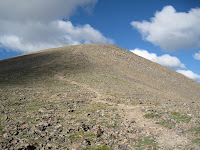
The top of Mt. Elbert
The last few hundred feet
La Plata from Mt. Elbert
La Plata from Elbert's summit

TRIP REPORTS