Showing posts with label featured route. Show all posts

Tuesday, October 22, 2013

Hot Route: Mount Massive, East Slopes

Length: 14 miles
Elevation gain: 4,600 feet
difficulty: class 2

OVERVIEW
Mount Massive east slopes
Mount Massive East Slopes
Mount Massive is a mountain that fits its name. It is truly a giant among lesser Colorado peaks. Although there are shorter ways to climb Massive than this standard route, the East Slopes is the easiest path to the summit from a technical standpoint. Almost the entire climb is on a well-traveled trail. The route is long, however, compared to many standard 14er hikes, and it will earn its name long before you stand on its top.

The East Slopes route on Massive is mostly a cruise and is one of the more popular 14er climbs in the Sawatch Range and probably the state. Don't expect solitude during the summer on this route. Still, this route is one of the classic 14er hikes in the state. Mount Massive is one of Colorado most, well, massive mountains. It sheer size makes it interesting to climb and powerful to include on your ticklist.

THE ROUTE
This first three miles of this climb follow wooded and mellow trail (part of the Colorado Trail). This trail (whose trailhead is almost exactly across the street from the trailhead for the North Mount Elbert Trail) takes you from just over 10,000 feet on Massive's southeast flank around to Massive's east side. After three miles, the trail meets a junction and turns west (left) toward the basin on the mountains east slopes. This trail junction is at 11,200 feet.

Snow on Mt. Massive
Late spring conditions on Massive
From here the route turn and quickly passses treeline, turning eventually into a long basin where Massive comes into view. It might seem close from here, but distances are deceiving. It may seem in this next section, that ou are hiking and hiking towards the mountain but it just keeps getting farther away.

Finally, after another 3 miles, you reach the saddle between Mount Massive's main summit and "South Massive," an unranked 14,000 sub-summit. From here it is just a short distance up a mildly scruffy class 2 slope to the top.

DIRECTIONS
From Highway 24 approximately 3 miles south of Leadville, turn west onto Highway 300. After .8 mile turn left (south) on CR-11. 1.2 miles farther, follow signs toward Halfmoon Creek and turn right. The Mt. Massive TH is five miles farther on the right (north) side of the road. There are several National Forest campsites in the area as well as dispersed camping. The more environmentally correct option is to stay in the developed, fee-based areas. If you must set-up in dispersed areas, please avoid building fire rings, there are plenty already. The Mount Massive trailhead is about one half-mile west of the North Mt. Elbert trailhead (which is on the opposite side of the road).

TRIP REPORTS
Redemption on Mount Massive- After turning around on Mt. Massive the year before due to lightning, we returned in 2011 to battle deep, rotten snow and a late-spring snowstorm to make the summit just in time to glissade down.

LINKS
Mt. Massive on 14ers.com

Mt. Massive on summitpost.org


South Massive from Mount Massive
Near the top
The final summit ridge on Mt. Massive
The final ridge

Visit THE ARCHIVE: A list of most of our articles sorted by department

find us on facebook


Copyright notice: This website and all its contents are the intellectual property of www.coloradomountaineering.com and its authors. None of the content can be used or reproduced without the approval of www.coloradomountaineering.com.

Climbing and mountaineering are dangerous!! Please see the DISCLAIMER page
For information about how to contact us, visit this link


Friday, September 20, 2013

Hot Route: Independence Tower Otto's Route (III 5.9 R)

Independence Monument in Western Colorado
Approaching Independence Monument
Trailhead: Lower Monument Canyon
Distance: 5 miles
Elevation gain: 1,200 feet
Difficulty: 4 pitches, 5.9

OVERVIEW
Independence Tower is not a mountain, nor is it alpine. It is a desert tower, which makes it somewhat rare for Colorado. And this is Otto's Route, a classic of Colorado climbing established in an age before climbing was set in its course towards what we know today.

Some people are against this route because it follows of line of chipped pipe holds the entire way. In a sense, I see their point. By modern standards this route would be an abomination. But John Otto, the man who drilled the holes in 1911 so he could insert pipe handholds, was considered a steward of nature and the forefront figure for establishing protection for the Colorado National Monument. He was an adventurer who loved these desert formations. If while climbing this route you are upset by the unnatural jugs throughout, consider a couple of things first: John Otto led this climb with a hemp rope in cowboy boots, without the chipped holds this route would probably go in the 5.11 range, and the chipping occurred over 100 years ago.

I encourage people, and I feel like most climbers who have climbed this route agree, to view Otto's as a historical route and not be bothered by its manufactured feel. It is still a great climb and the climbing itself despite everything is still fun. The positions are spectacular and the exposure is invigorating. Each pitch, not just the legendary pitch 4, has sections that are runout and hard to protect.

THE ROUTE
Approach: From the Lower Monument Trail, hike 2.5 miles (gaining 800 feet) to the base of Independence Monument. The route is on the northwest side of the tower following an obvious crack system. You will have to climb a small talus cone to get to the bottom.

Pitch 1: climb a 5.easy step to a junky 5.6 corner. Pass this to a nice finger crack with chopped steps. Climb up and left and gain a large ledge with a bolted belay. 130 feet (5.6)
Bighorn in the Colorado National Monument
You might have an audience...
Otto's Route (5.9) in Monument Canyon
Starting pitch 1
Pitch 2: move the belay to the right and scale a funky, over-hanging off-width. This would be a tricky pitch without the chopped holds. Here you will probably want a #4 and possibly a #5 too, though you can get away with less if you have good technique and a go-for-it attitude. There is some ledgefall potential pulling through the OW without big pieces. Pull, claw, thrutch through the OW and gain another huge belay ledge. Once you have belayed everyone up, most people with de-rope to pass through the next section. 70 feet (5.8+).

The OW P2 on Otto's Route
Climbing the overhanging OW on Pitch 2
The Time Tunnel on Otto's Route
The Time Tunnel between pitches 2 & 3

Scramble: Squeeze through the Time Tunnel, a tight gap between a the main tower and a detached spire. It is a little scrambly in one spot, maybe some minor, non-exposed class 3. At the other side is another massive belay ledge called the Lunch Box Ledge. Here you can leave most of your gear behind for the rest of the climb. All you need to get through the last 2 pitches are draws, maybe a few slings, optional tri-cams and gear to tie into the chain anchors at every belay.

Pitch 3: Pitch three is not hard or exposed, but it is runout between pitons. Tricams can be used in several spots but just trust those slightly sandy chopped buckets and the pitch will be over in no time. Climb up a seam and move up and right following the pipe holds through spaced pitons. Mantle a ledge and arrive at a bolted belay on Sundeck Ledge, where you might see get direct sunlight for the first time. Here the exposure might hit you for the first time. While this belay ledge is also large and comfortable, pitch 4 looms above you, and for some it can look pretty intimidating. 80 feet (5.7)

P3 of the classic Colorado climbing route Otto's Route (5.9)
Pitch 3 follows this seam then goes up and
right (the chopped holds can be seen
in the center). Pitch 4 can be seen top left
Pitches 3 ad 4
Pitches 3 & 4 seen from the Lunch Box Ledge
Pitch 4: This is the classic money pitch and a great lead for the grade. The position is spectacular and the exposure is tremendous. Leave the belay on the right-ish side of the fin and climb fifty feet of unprotected but easy climbing (5.3 R/X). Pay attention to your footwork and your hands on this sandy, dangerous section and keep your mind focused on careful movement. The climbing is easy and it's over in no time. There is potential to use a few tricams to moderate the danger somewhat. Clip a couple of solid pitons and arrive at the route's excellent crux: a fun overhang on massive, bucket holds. This section is well protected by pitons and there is potential for a couple cams to back them up if you want. It may be useful to extend a draw or two at the crux to reduce drag while top-belaying your follower. 90 feet (5.9)

Climber of the Pitch 4 crux of Otto's Route
Pulling the crux on P4 of Otto's Route
The top of Indy Tower
Looking down from the top of 
Independence Tower

Pitch 5: This "pitch" is really just a couple of moves from the big belay ledge at the top of P4. There is no protection, and the climbing is probably about 5.8. Some people "aid" through the botto by standing on the old flagpole base and/or the chains. What makes it a bit scary is that you are fully exposed at the top of the tower with air all around and no protection. Some choose to do this on belay. The top is spacious. On Independence Day you will find many people up here. You also have to downclimb P5, it is hard not to use the flagpole now.... Some people will want to be on belay for the downclimb too. NOTE: The flagpole has since been removed. You will have to climb the rock. There are still chopped holds, however, making it exciting because it is so exposed but not too difficult.

summit panorama from Independence tower
Panorama from the summit of Independence Tower
A shaky but mostly comprehensive helmet cam look at this route from Youtube:


Descent: Double-rope rap from the summit to the Lunch Box Ledge (the bottom of P3). Scramble back through the Time Tunnel. From the bolted anchor you can do a double rope rap (180') from these anchors straight to the ground or rap the route to the anchors of P1 (70 feet), then from these anchors to the ground (110 feet).

The first rappel
The first rappel to the Lunch Box Ledge

The last rappel

Rack: This could be debated and depends largely on your comfort. If you wanted to protect it as well as it can be, bring a full rack of cams to BD #4 Camalot (and possibly even a #5) with extras in the small to mid size, a set of tricams, slings, possible stoppers (though we didn't use any), 6-8 slings and 6-8 quickdraws.

DIRECTIONS
Independence Monument
Otto's Route follows the crack system right of center
then the top via the right skyline
Follow Grand Avenue from downtown Grand Junction west where it turns into Broadway and crosses the Colorado River. Continue on this road 8 miles through a neighbrhood and past many intersections (the road becomes Highway 340) until you reach a small dirt road marked with a sign for Lower Monument Canyon. This turnoff is notoriously easy to miss so be alert. There is a small parking lot here at this popular trailhead.

TRIP REPORTS
What does Independence Mean to You? Four days climbing in western Colorado including Unaweep Canyon, Monument Canyon, bouldering, and an ascent of Otto's Route on Independence Monument in the Colorado National Monument.

LINKS
Check out this helmet cam video guide for Otto's Route

Otto's Route on Mountainproject.com

Otto's Route on Summitpost.org

Monument Canyon- more info on climbing/hiking in Monument Canyon

Visit THE ARCHIVE: A list of most of our articles sorted by department

find us on facebook


Copyright notice: This website and all its contents are the intellectual property of www.coloradomountaineering.com and its authors. None of the content can be used or reproduced without the approval of www.coloradomountaineering.com.

Climbing and mountaineering are dangerous!! Please see the DISCLAIMER page
For information about how to contact us, visit this link


Wednesday, September 4, 2013

Hot Route: The DeCaLiBron (The Democrat, Cameron, Lincoln, Bross Loop)

Kite Lake Trailhead          
Length: 7 miles
Difficulty: class 2
Elevation gain: 3,500 feet
Exposure: Mild

OVERVIEW
Mt. Lincoln from Mt. Cameron
Mt. Lincoln in late spring
**NOTE** As of now the summit of Mt. Bross is closed to public access. Climbers that choose to o to the summit anyway could jeopardize future access, which the CFI (Colorado Fourteener Initiative) and CMC (Colorado Mountain Club) are currently fighting to obtain. The Bross portions of this historic route are included only for reference and in the hope that future access is restored.

The Decalibron is by far the easiest route in the state that allows you to collect four of the 59 fourteeners on the extended "59 List", and 3 of the 53 fourteeners on the standard list. In one big loop you can make a ring around this large cirque and collect Democrat, Cameron, Lincoln, and Bross. Since the trailhead at Kite Lake is over 12,000 feet and can be reached by a passenger car, this four-summit tour is highly abridged and quite popular.

Though the technical difficulty on this climb never exceeds class 2, the amount of time you are above 13,000 feet is substantial as is your exposure to weather. At the deepest points of the route the fastest way off is to simply continue around the cirque. As we discovered on a 2010 attempt of this ridge when we climbed in 80 mph winds, getting caught in the wrong conditions can be an unpleasant and even dangerous proposition.

THE ROUTE

The saddle between Colorado 14ers Mount Democrat and Mount Cameron
The saddle between Cameron
and Democrat from Democrat's
summit
From the Kite Lake trailhead, cross the creek and find a strong trail that heads north from the lake. Ascend the easy but winding class 1 trail to the 13,300 foot saddle between Democrat and Cameron. Turn left (west) and climb Mt. Democrat on a low class 2 trail. After enjoying Democrat's summit, descend back to the 13,300 foot saddle. Climb east to the rotund summit of Mt. Cameron, which is not ranked but usually included as one of the six unranked summits to be included in the 59 list.

From Cameron descend gently south to the saddle and it is only a short ways to Lincoln, the tallest route of the group. Lincoln's summit cap involves a small amount of boulder hopping. When you are done with Lincoln descend back to the saddle between Lincoln and Cameron and traverse to Cameron's east side to avoid having to re-climb to the top. Continue aroun the cirque to Bross and make a decision.

Mt. Bross on the Decalibron
Mt. Bross from Mt. Cameron
Currently, it is illegal to climb Mt. Bross, which is located on private property. It is legal to get within a few hundred feet of the summit and traverse on around to descend the West Slopes of Bross. Many people, eager to check off all of Colorado's 14ers, will quickly, quietly and respectfully make the out-and-back to Bross's summit and quietly move on. While it may be tempting to do so, you could jeopardize future access to the peak. Tread lightly!

The descent down Bross is steep and a bit gravelly at times, but very quickly you will be back down at your car.

DIRECTIONS
In the center of Alma turn west (right if coming from Hoosier Pass, left if coming from Fairplay) off Highway 9 onto Kite Lake Rd. Follow this mostly smooth dirt road for 6 miles to Kite Lake. In some conditions lower clearance cars will sometimes park a few turns below the lake but I've seen sports cars come rolling into the parking lot before. There is limited camping available here.

Mount Democrat in the snow
The last few, snowy feet on Democrat
TRIP REPORTS
Decalibron: How to Climb in a Hurricane- Eighty mile-per-hour winds and snowy conditions on the Democrat, Cameron, Lincoln, and Bross loop.

LINKS
Decalibron on 14ers.com

Decalibron on Summitpost.org

Colorado's Fourteeners: From Hikes to Climbs by Gerry Roach on Amazon.com- Better yet, buy this helpful and entertaining guidebook at your local gear shop or bookstore.

Visit THE ARCHIVE: A list of most of our articles sorted by department

find us on facebook

Follow us on Twitter!

Copyright notice: This website and all its contents are the intellectual property of www.coloradomountaineering.com and its authors. None of the content can be used or reproduced without the approval of www.coloradomountaineering.com.

Climbing and mountaineering are dangerous!! Please see the DISCLAIMER page
For information about how to contact us, visit this link


Friday, August 2, 2013

Featured Route: Wham Ridge (III 5.4) of Vestal Peak

A topo Wham Ridge
An approximate topo of Wham Ridge on Vestal Peak
Blue= standard version (5.4); Green="Center Shift" (5.6)
Molas Pass Trailhead          
Length: 19 miles
Difficulty: II 5.4 (III 5.6 for "Center Shift")
Elevation gain: 7,000 feet
Exposure: Moderate/high 
          Elk Park Trailhead
          Length: 12 miles
          Difficulty: II 5.4 (III 5.6 for "Center Shift")
          Elevation gain: 5,200 feet
          Exposure: Moderate/high

OVERVIEW
Vestal peak in the  rain
Vestal Peak towers above Vestal Basin
Wham Ridge is one of Colorado's most unique and best known technical alpine climbs. The rock is moderate, but the position and the surroundings are very rugged and dramatic. This portion of the San Juans is one of the most dramatic mountainous destinations in the entire state. Some of Colorado's most famous/infamous mountaineering peaks like in this ten square mile section of the Weminuche Wilderness, including but not limited to 14ers Eolus, North Eolus, Windom, and Sunlight, as well as thirteeners Pigeon Peak, Turret Peak, Jagged Mountain, Trinity Peak, Arrow Peak, and, of course, Vestal Peak. The Weminuche is the largest wilderness area in Colorado, and is teeming with wildlife, and beautiful flora. From both a backpacking and a mountaineering standpoint this is one of the most rugged and astounding places in the state.

Wham is a popular route for a technical alpine climb. It's moderate difficulty and ultra-aesthetic setting have made it one of the premier destinations for a first technical route for aspiring mountaineers. While it has a reputation of being easy, there are a few hazards that are worth mentioning that make any attempt at Wham become more than you bargained for.

First, Wham consists of quartzite. While it makes for some of the most solid rock in the entire range, it is akin to lubricated glass when it is wet. This stuff is slick. Play around on it even at camp after storm and you will see what I mean. This is no place to be in a storm.

Second, the descent is long and complicated. While it is only rated class 2+, it is long, loose and steep. It is easy to get sucked into class 3 terrain. Many people, too, have tried to descend directly south from the summit, only to find themselves pulled into even steeper and looser class 4.

Third, the San Juans are notorious for violent, long-lived storms. Their position on the western edge of the Rocky Mountains means that they are the first mountains to receive any weather systems blowing in with the trade winds. San Juan ski areas like Wolf Creek and Purgatory (Durango Mountain Resort) get some of the most snow in the state. The San Juans in turn get some of the most rain and some of the most violent weather of all the ranges in Colorado.

All of this being said, this one amazing part of the state, and any journey in is bound to be both challenging and rewarding. Wham Ridge of Vestal Peak is certainly worthy of its designation as a classic, and worth any trip for the mountaineer who is experienced and adventurous enough for the challenge.

THE ROUTE
The San Juans from Molas Trailhead
The Grenadiers from the Molas Trailhead
From Molas Trailhead, descend into the Animas River Canyon for five-hundred feet to an overlook at 10,100 feet. You can see the mountains in the distance, looking very far away. Still a long ways down.... Descend down the infamous 37 switchbacks (we counted 35). This arduous section drops over 1,300 feet to a very well-constructed footbridge over the Animas River at 8,800 feet. There is some limited camping in this area but the train tracks for the Durango and Silverton Narrow Gauge Railroad are only a few yards away.

Cross the tracks and find a good trail that starts to gently climb up the slopes on the east side of the river. After about half a mile, you join Elk Creek trail and come to a kiosk and register. It is a good idea, always, to take the moment to fill out the register. if you took the train in and got off at Elk Park, you will have walked an easy half mile to get to this point.

The next portion of the trail climbs a little under 1,000 feet in about two and half miles to a beautiful and obvious Beaver Pond at 9,900 feet. Arrow and Vestal can be seen up the basin from here to the south and there is good camping in the area of the beaver pond. On our last trip, we saw a moose here at the Beaver Pond.

The next section of the route is a bit arduous, especially if you are carrying a heavy backpack....
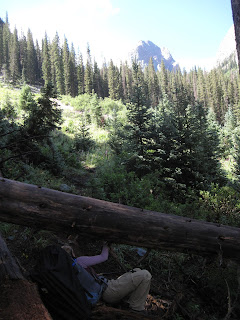
Ducking under logs heading to Vestal Basin
Ducking under logs on the way to Vestal Basin
At the east end of the beaver pond, leave Elk Creek trail and follow a strong climbers trail around a huge boulder on the east end of the pond. Follow this trail through a short wooded section with some good camping to a steep slope that drops down to Elk Creek. Crossing this creek in runoff seasons can be a bit treacherous depending on the presence/absence of a log bridge that is sometimes built here.

Cross the creek and start up what we dubbed "Hell Hill." The hill itself is only about 2 miles and gains just over 1,500 feet in elevation, but the trail is littered with downed trees and potential wrong turns. Stay high and stick to the main trail. Trying to stay closer to the creek will result only in rougher and steeper terrain you will have to negotiate.

At last you make it to the meadow at 11,500 feet in Vestal Basin. There are a couple of good campsites in the area, the best probably being on the left (east) side of the trail almost directly across from Wham itself. The mountains are beautiful and dramatic from this basin.

Climb up a steepening talus slope to the right of the obvious waterfall at the end of the meadow, and make your way to the bottom left corner of Wham Ridge (actually the peak's entire north face). Scramble up to a grassy ledge and do a rising traverse up and right to the face's west side just over 12,500 feet. So far the terrain shouldn't have exceeded class 3.

Scramble up the steepening face along its right side, roping up when and if you start feeling uncomfortable. There are a couple of decent splitter crack systems you can follow. The angle and difficulty steepen to low class 5 but just when it seems things are going to get really good, the rock becomes fractured and the climbing broken. Most people de-rope here and scramble the last few hundred feet on gunky class 4 to 5.easy to the summit.

Having fun with Wham
The Descent:
The descent is considered class 2+ but many people consider in class 3. It is long, loose and steep and not a great route to be on in a storm. From the summit descend southeast (not directly south, this leads to steep class 4 terrain) into a gully system on loose rock. Traverse when possible, following cairns for guidance, across the peak's south face, ultimately reaching the saddle between Vestal and Arrow Peaks. All that stand between you and the meadow is a gnarly downclimb down the slope Gerry Roach calls "Dues Collector" in his guidebook Colorado's Thirteeners: 13,800 to 13,999 feet. Back at the meadow you can relax (unless you have a train to catch) and be proud: you have just climbed one of Colorado's most aesthetic and classic mountaineering lines.

DIRECTIONS
The trailhead is found two miles north of Molas Pass on Highway 550 and five miles south of the town of Silverton. It is found in-between the turn offs for Molas and Little Molas Lake Campgrounds. The trailhead is a large dirt parking lot just off the highway on the canyon/mountain side.

TRIP REPORTS
Dirty (Wet) 30: or Five Rainy Days in the San Juans
Our attempt at Vestal and Arrow runs afoul of rain storms, bad navigation, and a general lack of time, but the trip was still one to remember.

LINKS
Mountainproject.com- Page on Wham Ridge standard route.

Summitpost.org- An information page on Wham Ridge (standard) route.


Visit THE ARCHIVE: A list of most of our articles sorted by department

find us on facebook

Follow us on Twitter!

Copyright notice: This website and all its contents are the intellectual property of www.coloradomountaineering.com and its authors. None of the content can be used or reproduced without the approval of www.coloradomountaineering.com.

Climbing and mountaineering are dangerous!! Please see the DISCLAIMER page
For information about how to contact us, visit this link


Sunday, June 16, 2013

Featured Route: Pyramid Peak, Northeast Ridge

Mountain Goat climbing Pyramid Peak in the Elks
The view from the summit of Pyramid Peak in the Elk Mountain Range
Length: 8 miles
Elevation gain: 4,420 feet
Difficulty: class 4 (loose steep rock, moderate route finding challenges)
Exposure: moderate

From Maroon Lake, follow the Crater Lake trail for 1.5 miles to a level clearing filled with glacial moraine boulders. Find a trail on the left (south) side of the trail marked by a large cairn. Follow this trail as it switchbacks through the forest and across some scree slopes to a notch left of a large pinnacle. The trail end at the terminus of a large rock glacier that empties an “amphitheater” at the bottom of Pyramid’s North Face. Follow the path of least resistance up the rock glacier to the bottom of the face, turn left (east) to the bottom of a scree slope left of the main difficulties of the North Face. The approach is over.

A view of the Maroon Bells
A mountain goat up close
Climb steep, loose scree on a well-trodden climbers trail 1,000’ to a saddle a little less than 13,000’. The rest of the route is visible above you. Ascend the ridge, staying mostly on its right side past another, smaller saddle up to a notch with a steep headwall. Descend through some boulders to the left side of the ridge. Find a climbers trail that traverses over a couple rock ribs and across the “Cliff Traverse”, a narrow ledge that pinches down to a narrow crux in the middle. Continue on a strong climber’s trail past another rock rib, across a dirty gully until you reach the Green Couloir.

The gully that leads to the saddle
The Cliff Traverse on Pyramid Peak

Now the fun part begins. Climb the Green Couloir for a couple hundred feet, being very cautious with loose rock (class 3). It might be best to climb this one at a time to avoid knocking rocks on each other. Exit the green rock left at some cairns and climb steepening rock through several cliffbands. There are several ways to negotiate this section, the path of least resistance climbs a small chimney and cliffband crux that are both class 4. Keep in mind that downclimbing is harder for most people. Stay left of the ridge itself and make a few class 3 moves just before breaking loose onto the amazing summit. Enjoy one of my favorite summit platforms.

The Green Couloir
A mountain goat watches a human mountain goat on Pyramid Peak
The narrow summit of Pyramid Peak
The Maroon Bells from the summit of Pyramid Peak


Visit THE ARCHIVE: A list of most of our articles sorted by department

find us on facebook

Copyright notice: This website and all its contents are the intellectual property of www.coloradomountaineering.com and its authors. None of the content can be used or reproduced without the approval of www.coloradomountaineering.com.

Climbing and mountaineering are dangerous!! Please see the DISCLAIMER page
For information about how to contact us, visit this link


Monday, June 3, 2013

Featured Route: Snowmass Mountain East Slopes

EAST SLOPES OF SNOWMASS MOUNTAIN
Length: 22 miles
Total Elevation gain: 5,700'
Difficulty: class 3

OVERVIEW
Snowmass Peak and Snowmass Lake
The East Slopes (standard) route on Snowmass Mountain is one of Colorado's most spectacular 14er adventures. At 22 miles, it is a very long hike, and I recommend 2 days. Though the hike in and out will be more difficult with the extra gear, the extra time will allow you to take your time and enjoy this beautiful place. Although Snowmass Lake is very likely one of the busiest lakes in the Colorado's backcountry, it is quite beautiful and offers numerous opportunities for places to camp.

Like most climbs in the Elk Range, the East Slopes of Snowmass Mountain is steep, loose and dangerous. It has proven fatal for several mountaineers over the years. Almost the entire route once you have passed the Snowmass Lake is one slippery scree and once you have pass around 13,500' the route becomes particularly dangerous. Wear a helmet, use caution, and be careful not to climb directly underneath another party.

THE ROUTE
Snowmass Lake at sunrise
The long approach to the East Slopes of Snowmass Mountain is one of the longest for any standard route on a 14er in Colorado. The approach alone is over 8 miles and gains over 2,500' in elevation. The hike is long an provides some beautiful views. After 6.5 miles you must cross the creek. This can be a challenge at high spring runoff levels. Depending on the flow level/wood conditions people usually tiptoe across a log jam. If the water is low you can sometimes cross the creek directly below the jam. Not far after negotiating this obstacle, you reach the lake itself. There are many good campsites here. Beware, however, of rules against camping too close to the lake and against fire in general.

the East Slopes of Snowmass Mountain
Hike along the east and south sides of the lake and find a climber's trail that starts up the loose rock on the lake's west end. The approach is over. Climb up the steepening slope along a vague climber's trail into the huge basin on Snowmass Peak's east slopes. Depending on the time of year and conditions there may be some snow to climb at the top of this basin. The usual route veers a bit south as you approach the ridge and finds a notch through the cliffs to reach the summit ridge. In dry, late-summer conditions, or if the snow covering is complete, you can hike more directly towards the summit, finding a breach in the cliffs and reaching the summit ridge near 13,900'. From here you traverse slightly onto the west side of the mountain and pick your way through some class 3 boulders to the summit.

From the summit of Snowmass Mountain looking towards Capitol Peak
 Looking across to Capitol Peak from Snowmass's summit
DIRECTIONS
From Highway 82 28 miles south of Glenwood Springs (or 13 miles north of the roundabout in Aspen) turn west at the town of Old Snowmass (not to be confused with Snowmass Village, the ski area) onto Snowmass Creek Road. Turn left at a T-junction after a mile and a half (right will take you to Capitol). You hit the dirt road seven miles after turning off Hwy 82 and cross the creek at mile 10.5. Take a right at another intersection a half mile later and the trailhead is only about a quarter-mile beyond that.

TRIP REPORTS
the summit area of Snowmass Mountain in the Elk Mountains of Colorado
The summit of Snowmass Mtn
Geneva Lake, Snowmass Mountain, and the Four Pass Loop- A seven day backpack trip following the Four Pass Loop but also with extensions to Geneva Lake and an ascent of the East Slopes (standard) route of Snowmass Mountain.

LINKS
East Slopes on Summitpost.org

East slopes on 14ers.com


Visit THE ARCHIVE: A list of most of our articles sorted by department

find us on facebook


Copyright notice: This website and all its contents are the intellectual property of www.coloradomountaineering.com and its authors. None of the content can be used or reproduced without the approval of www.coloradomountaineering.com.

Climbing and mountaineering are dangerous!! Please see the DISCLAIMER page
For information about how to contact us, visit this link


Wednesday, February 13, 2013

Hanging Lake: Gem of the White River National Forest

INTRODUCTION

Hanging Lake, Glenwood Canyon
Hanging Lake in summer
This ultra-popular hike is in Glenwood Canyon east of Glenwood Springs. The trail ascends 1,200’ in about a mile and a half from the Hanging Lake Trailhead to the teal-blue waters of Hanging Lake. A series of beautiful waterfalls at the top makes this a worthwhile adventure. This hike draws a great deal of attention, particularly on summer weekends. For more solitude, hike Hanging Lake in the off-season such as fall when the air temps are not as high, the crowds are down, and the colors are out. The trail up Hanging Lake is solid and well-maintained. Despite this, many people underestimate the effort required on the steep route that leads back to the lake. For the experienced hiker, however, Hanging Lake is little more than a moderate workout in a gorgeous setting.

GETTING THERE
From Glenwood Springs, drive east on I-70 nine miles to the Hanging Lake exit (exit 125). This exit is only accessible from the eastbound lanes, so drivers coming from the east will have to exit and turn around at exit 121 (Grizzly Creek) to get there. Park at the large rest stop (which will fill despite its size on a busy summer weekend) and hike .5 mile east along the Glenwood Canyon Bike Path to reach the trailhead.

Winter in Glenwood Canyon
Hanging Lake Canyon in winter
THE ROUTE

While this hike is on a solid trail the entire way, it is important to note that it is strenuous. Many people undertake this hike thinking that it's going to be a casual journey; it is not. You will probably pass many un-shapely humanoids struggling and complaining their way up this trail. For a true hiking enthusiast, however, making it to the lake shouldn’t be a problem.

The trail follows Deadhorse Creek up the northern side of Glenwood Canyon, passing many rapids and waterfalls along the way. There are several footbridges and plenty of shady places to stop and rest. The trail becomes considerably steeper near the end as you circumnavigate Bridal Veil Falls just below Hanging Lake proper. The very last pitch is the steepest, and steps have been cut into the stone to help you along. In addition, a handrail has been constructed for protection. Despite these safety features, it seems like several people get injured up here every year.


Spouting Rock
Spouting Rock above Hanging Lake
Once past the steepest section you arrive at Hanging Lake. Here a beautiful, multi-ribbon, 40’ waterfall pours into a teal-green pool formed by travertine “teacup” deposits. This travertine is very fragile and takes eons to form. To protect this fragile wonder, a wooden walkway has been constructed around the lake. Please be respectful of this amazing place and stay on the boardwalk.

For those seeking a little adventure, a spur trail climbs up and around the main waterfall to Spouting Rock, a peculiar waterfall which partially erupts directly from the cliff. You can walk behind the waterfall here for a unique perspective and even stand under it if the water is low enough. Take caution, however, this plunge generates some powerful forces!

CAMPING
The nearest camping is at the Glenwood Canyon Resort off the No Name Exit in Glenwood Canyon (a few miles west of Hanging Lake). Here you will find cabins, showers, and slightly overpriced tent sites.

Hanging Lake in winter
Spouting Rock
Winter at Spouting Rock
Visit THE ARCHIVE: A list of most of our articles sorted by department

find us on facebook

Copyright notice: This website and all its contents are the intellectual property of www.coloradomountaineering.com and its authors. None of the content can be used or reproduced without the approval of www.coloradomountaineering.com.

Climbing and mountaineering are dangerous!! Please see the DISCLAIMER page
For information about how to contact us, visit this link