Wednesday, June 19, 2019

American Mountaineering Museum in Golden to Host Art by Coloradoan

A press release from the American Mountaineering Museum in Golden:

The American Mountaineering Museum (AMM) in Golden, Colorado is the first and only museum in the nation dedicated to mountaineering history. Since its founding in February 2008, the museum has pioneered a new approach to interpreting knowledge about mountains and educating people on mountaineering history, safety, and mountain culture. Artist Topher Straus cultivated his love of the outdoors in his native Colorado and has been recently hard at work in his Golden studio creating an innovative series of paintings highlighting U.S National Parks. Given the natural connection of subject matter and as an active supporter of their local community, the museum is pleased to feature these works in a solo exhibition, Topher Straus: The Parks.

The public is invited to a free opening reception at the museum 710 10th St. in Golden on Thursday July 18 from 6-9 pm. Attendees will enjoy drinks, nibbles and chance to meet the artist. The exhibit will be on view through September 30th, 2019 during regular museum hours, Monday, Tuesday, Thursday and Friday 10-4 pm, Wednesdays 10-6 pm and Saturdays 12-5pm. Adult admission is $7.

Inspired by his own exploration of the outdoors and a strong desire for continued preservation, Straus' large-scale paintings take an original approach to depicting iconic national park landscapes around the United States. He is proud to show his work in the area that his fostered life-long connection to nature. His process blends photography with digital painting, with the final image printed onto large sheets of aluminum and finished off with a high-gloss transparent acrylic resin finish. The results are dynamic abstractions of familiar park scenery that pop with color. Michael Paglia, Art Critic for Denver's Westword recently reviewed this series with the following observations:

"Given the high-tech methods and the semi-gloss surfaces, the result could be too slick and commercial, but the expressionistic handling of the outlined forms prevents that. The landscapes are simplified and conventionalized abstractions of the views and have a retro-cubist quality, along with a dash of Yellow Submarine." 

Colorado native Topher Straus left the state to attend Syracuse University, where he graduated with a Bachelor of Fine Arts in Film Art. He pursued a career in documentary, narrative films and advertising that took him to Los Angeles and later, New Zealand. Upon returning to Denver in 2012, he shifted gears and began fervently working in his studio as a full-time artist, quickly landing his first solo exhibit. His second solo show, The Parks, was featured at Niza Knoll Gallery early in 2019. He is an active, enthusiastic promoter of his own work and the art community as a whole. Follow Topher on Instagram @CreativeTopher and his website at TopherStraus.com

The Bradford Washburn American Mountaineering Museum seeks to preserve the history and spirit of mountaineering, to educate visitors on mountain culture and the sport of mountaineering, and to inspire in the modern climber a greater appreciation for climbing history. Known as the nation's foremost destination to experience and research mountain history, the museum's unparalleled and varied collection offers a comprehensive field view.  For more information visit www.mountaineeringmuseum.org


Friday, January 26, 2018

UPDATED: Stats and Analysis of 14er Deaths This Decade (2010-2017)

The blossoming popularity of hiking and climbing on Colorado's 14ers has also brought an increase in accidents on these peaks. This article is an attempt to analyze the statistics from these terrible incidents and (hopefully) discover some useful conclusions to prevent such tragedies from occurring again in the future.

The Elk Range, statistically one of the most dangerous
ranges in the state
While every effort has been made to ensure that the data is complete, it is quite possible that some or several accidents have been overlooked. Every year there are accidents that go unreported and sifting through the barrage of information on the internet is not easy, especially regarding events that may have occurred several years ago. Still, this information can prove a useful tool in keeping all of who venture into the highest places of  this amazing state safe.

UPDATED
This article was originally published 1/3/17 but has been updated to include data from the tragic 2017 season.

STATS AT A GLANCE

Total deaths on Colorado 14ers (2010-2017): 57
Deaths by mountain: Longs Peak (9), Maroon Bells (9), Capitol (7), Crestone Needle (5), Crestone Peak (3), Kit Carson (3),  Snowmass Mountain (2), El Diente (2), Harvard (2), Evans (2), Missouri (2), Torreys (2), Princeton (2), Quandary (1), Windom (1), Antero (1),  Little Bear (1), Yale (1), Blanca (1), Challenger Point (1)
Deaths by gender: M (50), F (7)
Deaths by age range: >20 (2), 20-29 (16), 30-39 (16), 40-49 (6), 50-59 (13), 60 or over (5)
14er deaths by mountain range: Elk Range (18), Sangre De Cristo (14), Front Range (13),   Sawatch Range (8), San Juan Range (3), Tenmile-Mosquito Range (1)
Deaths by Cause: fall (38), falling rocks (5), avalanche (3), heart attack (2), lightning (1), unclear (8)
Deaths by Year: 2010 (10), 2011 (10), 2012 (6), 2013 (5), 2014 (6), 2015 (4), 2016 (5), 2017 (11)


(Note: I have combined the Maroon Bells in the above list due to the number of accidents that occurred on the traverse between them making it hard to attribute these deaths to one or the other of these peaks) 


ANALYSIS/CONCLUSIONS

There are a few glaring details from the above statistics that are immediately apparent. For one, more than half of these deaths (33) occurred on only six mountains (Longs Peak, the Maroon Bells, Capitol Peak, and the Crestones). While none of these should really come as a surprise, it is interesting to see just how concentrated this list is. Longs Peak attracts a high number of accidents (almost all of which occurred on the standard Keyhole Route) because it's steep and exposed from every approach. On the Crestones, it is noteworthy that half of the eight deaths between the two of them occurred on Crestone Needle's Ellingwood Arete, a technical (5.7) multipitch climb, and only three fatal accidents have occurred on their standard routes. Per capita, the Deadly Bells lead for the dubious prize so far this decade as the most dangerous 14ers by their easiest lines. It doesn't take a Nobel Prize winner to understand why: these stunning peaks maybe be beautiful but their rock is far from it.

In 2017 Capitol Peak gained notoriety when five people died on its slopes. Three of these five victims died as a result of selecting the incorrect descent route. The so-dubbed "Death Gully" has lured people in the past due to its innocuous appearance from above and people's fear of crossing the Knife Edge on the return journey. It is imperative for aspiring climbers of Capitol Peak to understand THERE IS NO EASIER WAY to climb this mountain than the standard route. If there was an easier route, that would be the standard route! 

Another glaring and thought-provoking statistic is the ratio of males to females that have died on Colorado 14ers. A staggering 88% of the 14er fatalities this decade were males. From an analytical standpoint it is hard to say whether this reflects the numbers of males attempting 14ers over the numbers of females or some other factor (i.e. male tendency towards risk-taking, etc.)

It is also quite clear that the 14ers of the Sangre De Cristo and Elk Ranges are the deadliest. While the Front Range is tied with the Sangres for most fatal accidents total, this stat is skewed by the sheer number of attempts, as the Front Range 14ers (particularly Longs) are some of the state's most popular.

Analyzing the cause of death was somewhat challenging. Some of the information listed multiple causes, i.e. a falling rock strikes a climber causing them to lose their grip and fall. This sort of accident makes it difficult to categorize the accident. With other accidents vague reporting (often by reporters who have little or no mountaineering experience) made determining the actual cause of death very difficult. One thing is clear, however, is that the majority of 14er deaths involved a fatal fall on a mountain. The cause of these falls, however, is vitally important and sometimes difficult to say. My guess is that most occur due to breaking hand or footholds. The other leading causes of accidents are rockfalls/landslides and avalanches.

SOME SURPRISES
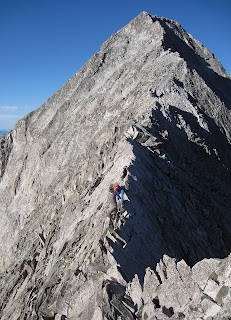
Capitol Peak a 14er in Colorado's deadly Elk Range
Capitol Peak has been site of seven fatal accidents
so far this decade, including five in 2017 alone
What can also be useful from a data set like this is considering not just what is there but what is not. For example, neither Sunlight Peak, Wilson Peak, nor Pyramid Peak appear on this list. These three mountains are oft-touted as some of the hardest/most dangerous in the state yet nobody has died on any of them so far this decade. Also, there was only one death on Little Bear, another peak that is often regarded as the most dangerous of all the 14ers. In all these instances, however, these low numbers could be the product of much fewer numbers of attempts.

The San Juans. A beautiful range with a large number of rugged 14ers notorious for crumbly rock, yet we only see three deaths from this range. This again, could partially be a product of their distance from the populous cities of the Front Range, and therefore enjoy a proportionally smaller number of attempts. Or maybe the San Juans are not as fierce or chossy as their reputation makes out.

HOW TO AVOID AN ACCIDENT

Statistically speaking, there are a couple of easy things you can do to virtually eliminate your odds of ending up on a list like this in the future:

1) If your main goal in Colorado mountaineering is simply not to die, then do NOT climb the Maroon Bells, Capitol Peak, Longs Peak, or the Crestones. Again, over half of the fatal accidents this decade have occurred on these six peaks. Of course, many people simply cannot put their backs to the siren call of these dangerous peaks. For those, perhaps extra care should be taken to exercise the greatest possible caution: climb in good weather, wear a helmet, start early, avoid crowds, and tread lightly!

2) Be a woman. Apparently simply being a woman slices your chances of dying on a 14er considerably. However, I have not been able to find reliable stats on the ratio of female to male climbers attempting 14ers, or even better, starting out on individual peaks, so it is hard to know a woman's odds of dying are actually slimmer or if the difference is merely proportional.

3) Avoid falling. Of course this is always the goal, but most of the fatal accidents on 14ers involved the victim falling. From my experience reading about these accidents, breaking/crumbling hand or footholds is almost always the cause of falling related accidents. Maintain three points of contact on the difficult sections of steep mountains at all times, carefully test hold before weighting them, and rope up if it is safe and practical (which, unfortunately, is often not possible on the loose rock of some of Colorado's most dangerous mountains).

FINAL THOUGHTS

Though many of us like to say we "live" for the mountains, probably none of us wants to die there before our time. We accept a certain degree of risk knowing risk is the only path to reward. These 46 deaths are all tragic. The widespread consequences of losing even one life can ripple out and touch so many. But compared to the tens (perhaps hundreds) of thousands of people that attempted Colorado's 14ers this decade, 45 deaths is a very small percentage. We all venture to these high places knowing what risks we take and the potential consequences of our actions. We are willing to accept these calculated risks because it is only in the mountains that we truly feel alive.

RELATED POSTS


 Visit THE ARCHIVE: A list of most of our articles sorted by department

find us on facebook

Follow us on Twitter!

Copyright notice: This website and all its contents are the intellectual property of www.coloradomountaineering.com and its authors. None of the content can be used or reproduced without the approval of www.coloradomountaineering.com.

Climbing and mountaineering are dangerous!! Please see the DISCLAIMER page
For information about how to contact us, visit this link


Sunday, November 12, 2017

Tempting Fate on McGregor Mountain in RMNP

Five-hundred feet up a slick rock face with a storm moving in and I was about to die….

McGregor Mountain looms of the Fall River entrance
of Rocky Mountain National Park
At least that’s how it seemed as I clung desperately to the blank slab of granite, legs gyrating in fear, with crackles of thunder drawing closer. I’d forgotten how fast blue skies could turn to slate-gray in Rocky Mountain National Park in July above treeline. But frightening as it was being exposed to lightning, the impending storm was the last thing on my mind. I needed focus. Somewhere on the supposedly easy three-pitch 5.5 rock climb on McGregor Mountain, my wife, Ella, and I had gotten lost. Off-route and fifty feet above the last marginal piece of protection that might arrest a potential fall, I was stuck.

Best case scenario a drop now would entail one-hundred feet of sliding, scraping and tumbling down the mountain. With plenty of ledges and sporadic trees to smash into, the consequences of such a fall were too terrible to imagination. The less I tried to think about them, however, the more readily the images come to mind: broken limbs, snapped vertebrae. I doubt even my helmet would do much good.

Above, the rock steepened. The terrain was closer to 5.9 than 5.5 and slippery with the loam of disuse. Great cracks where I could install gear to catch a fall were tantalizingly close on both sides, but getting to them looked nearly impossible. How could this have happened? The whole situation, the very real possibility of disaster on what should have been a fun, mild afternoon outing, was starting to seem surreal, like one of those bad dreams from which you shake yourself awake and laugh. 

Panic nearly choked me. With Ella somewhere out of sight far below me and well beyond earshot, I was quite alone. How much longer could my quaking legs hold on before they shook me off the rock and sent me caroming down to face my doom? Climbing any direction was dangerous, but I could only hold on for so long. That one-hundred-foot tumbling whipper was drawing closer. 

An ill-timed crack of thunder, the closest yet, echoed off the tall, rugged peaks. The storm would soon be upon us.

*
In 2012 the Rocky Mountain Rescue Group, an organization of all-volunteer responders who specialize in rescues on mountainous terrain in Boulder County, published a report with analysis of all incidents in Boulder County involving rock climbing and hiking over a 14-year period. Although RMRG does not cover Rocky Mountain National Park, the group services nearby Boulder Canon, Eldorado Canyon and the Flatirons, some of the most popular climbing areas in the state. This large sample size provides a unique cross section of climbing-related injuries and fatalities.

Although the potential of falling while lead climbing is a predominant fear in the mind of most rock climbers, as it turns out it is not nearly the most common cause of injury or death. While RMRG was called to assist 428 rock climbing accidents in this period, only 5 were fatal incidents involving roped lead climbing. A much higher ratio (12%) were involved in belayer-error incidents and an even higher number (as much as 45%) involved rappelling and/or getting lost on the descent. 

Although the inglorious “whipper,” as a roped lead fall is often called, tends to dominate the Youtube videos and rock climbing tales of woe, it seems the things often taken for granted (i.e. your belay partner or your ability to get safely off the mountain) more often than not prove to be more treacherous. Knowing the relative safety of lead climbing, however, does little to calm quaking nerves when faced with the possibility of a dangerous fall on a difficult rock climb.

*
Time was up. I could delay no longer. Action had to be taken before I simply peeled off the mountain in exhaustion. 

Belaying Ella up the first ptich
I was tempted again by the safe crack system some twenty feet to my left. Getting there, however, involved crossing a strip of impossibly blank rock, no hand or foot holds in sight. A ridiculous part of my mind considered just lunging for it. Going right looked steeper and even more dangerous. Downclimbing was an option, but leading with your feet was always considerably more difficult than with your hands, so I quickly ruled it out.

The only real choice that remained was to go up. Although every bit I climbed would increase the length and danger of a fall, it seemed that in order to find safety I would have to swim through the belly of the beast.

The smooth shield of granite above was broken only by a thin seam. Though it was not deep enough to sink in spring-loaded cams capable of catching a fall, it provided just enough texture for my fingers and toes to scale upward. I pulled higher and higher, increasing the fall potential with every move. I climbed ten feet. Twenty feet. I was so far above my protection now it was almost comical. My life depended on the grip of my fingers, and the friction between my rubber shoes on the slick granite. The slightest slip or broken rock and my worst nightmare would rush upward to meet me. Would it hurt to take a fall like that? Or would it happen so fast the lights would simply go out in a blink?

I was eighty feet above my last cam. Then one-hundred. It had to end eventually. This rock couldn’t go on forever.

Then abruptly, almost magically, a crack appeared in front of my eyes. I was so focused I nearly climbed past it. Shocked I had made it, I plugged in a cam and clipped in my rope with disbelief. I was safe. I installed a second cam just to be sure. The earthquake in my legs slowed. I wasn’t going to die today.

Not long after, the angle of the wall flattened and I found myself standing on the top. The storm I had thought was building had swung far to the north. I constructed an anchor and began to belay Ella up to join me. 

Already my fear from just a few minutes before was beginning to fade. Surely, I had not been in nearly as much danger as I’d thought. Here I was, not injured or lost or stranded. In every sense of the word the climb was a complete success. I stood atop a mountain with a sea of beautiful ridges and notched spines all around. Blue sky broke through the clouds.

It was a perfect day.

NOTE: This article originally appeared in the August 2017 issue of Our Backyard, a regional publication focused on outdoor stories of intrigue and woe
-------------------------------------------------------------------------------------------------------
Visit THE ARCHIVE: A list of most of our articles sorted by department

find us on facebook


Copyright notice: This website and all its contents are the intellectual property of www.coloradomountaineering.com and its authors. None of the content can be used or reproduced without the approval of www.coloradomountaineering.com.

Climbing and mountaineering are dangerous!! Please see the DISCLAIMER page
For information about how to contact us, visit this link


Wednesday, October 11, 2017

Hayden Kennedy: A Celebration of Accomplishments

by Brian Wright

Colorado Mountaineering was sickened to learn yesterday about the deaths of Hayden Kennedy and his partner/girlfriend Inge Perkins. 

Screenshot from an interview where Kennedy describes his
decision to chop bolts off the Compressor Route on
Cerro Torre in Patagoina
Hayden Kennedy was a living legend in my mind, and a climber I looked up to as someone I could only dream of emulating. I first met him when he was still a young teenager learning how to whitewater kayak. I was an instructor at the local whitewater paddling shop at the time, and remember being impressed by Hayden and his entire family. I never got to know Hayden very well. In fact, he probably wouldn't have remembered my name if I saw him on the street. But I remembered him and I always felt a bit in awe of his understated skills and humility.

I was very touched by a poignant article he wrote for eveningsends.com just a few weeks ago. I read it last night after hearing the news of this terrible sequence of events. Some of his incredibly well-written words are even more moving in retrospect, knowing what was looming unknown in his near future. His article can be read here.

The details of this tragedy have been reported on by numerous news outlets. One informative article can be found on Climbing Magazine's website. The purpose of this post, however, is to celebrate some of Kennedy's accomplishments and share a few videos that highlight his tremendous success and skill as a mountaineer and a person.

Kennedy and Kyle Dempster discussing their climb on the South Face of the Ogre in Pakistan for which they won the Piolets d'Or, the most prestigious award in climbing. (Note: Dempster also died in a climbing accident in 2016 on a remote mountain in China)


Hayden dropping some cliffs during a telemark extreme skiing championship


Hayden discusses his decision to cut bolts of the Compressor Route on Cerro Torre in Patagonia


I was not able to find a video of Hayden making the first ascent of Carbondale Shortbus in Indian Creek. The old video I had linked in several posts has since been taken down. I have however linked a video of Nick Martino working this route, so you can get an idea of the challenge and skill this project required.


-------------------------------------------------------------------------------
Visit THE ARCHIVE: A list of most of our articles sorted by department

find us on facebook


Copyright notice: This website and all its contents are the intellectual property of www.coloradomountaineering.com and its authors. None of the content can be used or reproduced without the approval of www.coloradomountaineering.com.

Climbing and mountaineering are dangerous!! Please see the DISCLAIMER page
For information about how to contact us, visit this link


Sunday, October 8, 2017

VIDEO: Boulder Woman Makes First Female Ascent of a Confirmed 5.15

This didn't take place in Colorado, but Boulderite Margo Hayes became the first woman to climb a confirmed 5.15 this year when she climbed Chris Sharma's mega-classic La Rambla. This short video is a teaser of that historic climbing moment.


Tuesday, August 22, 2017

NEWS: UPDATED More Tragedy, Couple Found Dead on Capitol Peak (8/22/2017)

missing couple found dead on Capitol Peak
The North Face of Capitol Peak, a mountain that has
claimed the lives of four mountaineers in just over a month
The extreme year for accidents in the Elk Range persists. A couple described as "in their mid to late 20's" were found dead on Capitol Peak today. The reports were mixed, some describing the location of the bodies as "near the summit" and others saying they were "at the base of the north face." Given the steepness and scale of this aspect of the mountain, these two reports would appear contradictory.

According to sources, the couple had "tentative plans" and many suspected they might have stayed longer than expected in the area to view Monday's eclipse. This confusion led to a lapse in reaction time in the search for the missing couple. Once it was clear they had not returned as planned, a search was mounted which led to the discovery of the bodies.

According to a press release by the Pitkin County Sheriff Department, witnesses on the mountain the day of the accident, which is thought to have occurred on Sunday, suggested the couple likely summited the mountain but may have decided to descend via a different route. Those familiar with Capitol Peak know that there is no viable route for descent besides the standard Northeast Ridge, especially without ropes.

Though the names of the deceased have not been officially released pending notification of next of kin, Aspen Public Radio is reporting that someone close to victims has released their names. You can find their article at this link.

This latest accident tops off what has been a grim, record-setting year for the Elk Range. Four climbers have been killed on Capitol Peak and an additional two have been killed on the Maroon Bells. These peaks, renowned for their beauty, are notoriously dangerous to climb and have proven fatal for many adventurers over the years.

A story published in January on Colorado Mountaineering analyzing the deaths on Colorado's 14ers since 2010 and showed that the Elk Range hosts an abnormal percentage of fatal accidents on Colorado's 14ers.

UPDATED (8/23/17) The deceased have been identified as Carlin Brightwell and Ryan Marcil. The couple was described as having dated for a number of months and recently moving in together. Our thoughts are with the family and friends of these victims.


RELATED HEADLINES

-Climber Dies on Capitol Peak (7/19/2017)
-Another Climber Killed on Capitol Peak (8/6/2017)
-Statistical Analysis of 14er Deaths this Decade (2010-2016)

Visit THE ARCHIVE: A list of most of our articles sorted by department

find us on facebook

Copyright notice: This website and all its contents are the intellectual property of www.coloradomountaineering.com and its authors. None of the content can be used or reproduced without the approval of www.coloradomountaineering.com.

Climbing and mountaineering are dangerous!! Please see the DISCLAIMER page
For information about how to contact us, visit this link


Tuesday, August 8, 2017

NEWS: Missing Woman Found Dead on North Maroon Peak (8/8/2017)

Rei Hwa Lee was found dead on North Maroon Peak in August 2017
The Maroon Bells. The North Face of North Maroon
is prominently visible right of center, to the right of the tree
A hiker who had been missing since Sunday was found dead on the North Face of North Maroon Peak today. It has been reported that Rei Hwa Lee, 57, of Littleton was found by Mountain Rescue Aspen this morning shortly after 11 am according to a story posted by the Aspen Times. This news comes only two days after another death on nearby Capitol Peak.

Though the exact line taken by Lee is difficult to determine from reports, the North Face of North Maroon is a non-standard route known for its precarious rock and steep exposure. Lee was hiking alone at the time.

As Colorado Mountaineering reported in January, the Maroon Bells have proven to be some of the most dangerous 14ers in the state. Combined with Crestone Peak, Crestone Needle and Longs Peak, these five mountains have accounted for half of the fatal accidents on all 14ers this decade. This latest tragedy marks the fourth death on an Elk Range 14er this year and the sixth death on a 14er this year across the state.

RELATED HEADLINES


Visit THE ARCHIVE: A list of most of our articles sorted by department

find us on facebook


Copyright notice: This website and all its contents are the intellectual property of www.coloradomountaineering.com and its authors. None of the content can be used or reproduced without the approval of www.coloradomountaineering.com.

Climbing and mountaineering are dangerous!! Please see the DISCLAIMER page
For information about how to contact us, visit this link


Sunday, August 6, 2017

NEWS: Another Climber Dies on Capitol Peak (8/6/2017) *UPDATED*

The Knife Edge on Capitol Peak, site of a fatal accident this morning
A climber died this morning from an apparent fall from the infamous Knife Edge on Capitol Peak. According to a report on 9news.com, the hiker fell from the notoriously exposed crux of the mountain that is oft-touted as Colorado's hardest 14er. Friends who were with the victim said he fell to east side of the skinny ridgeline.

A recovery team was inserted on the scene by helicopter but determined the injuries were too severe to warrant a rescue. The inaccessible terrain and unfavorable weather conditions made recovery too dangerous. The recovery operation was hoped to resume on Wednesday.

As of yet the victim has only been identified as a "male." This is the second fatal accident on the infamous Elk Range 14er. Twenty-five-year-old Jake Lord was killed in mid-July when a boulder he was clinging to broke free, causing him to fall several hundred feet.

Though accidents on the Knife Edge are rare, this particular section has been the site of several fatal accidents in the past. Our thoughts are with the friends and family of the victim.

*UPDATE (8/11)* After what rescuers described as "one of the most difficult recoveries in decades" volunteers from Mountain Rescue Aspen were able to retrieve the body of the man who fell from Capitol Peak. While early reports indicated he had fallen from the infamous feature known as the Knife Edge, it is now being said that the victim had not yet reached that portion of the route but was "in-between K2 and the Knife Edge."

The deceased has been identified as Jeremy Shull, a 35-year-old from Parker, Colorado. Shull was married with a 2-month-old baby.

A detailed account of the rescue operation was reported in Aspen Times

RELATED HEADLINES


Visit THE ARCHIVE: A list of most of our articles sorted by department

find us on facebook


Copyright notice: This website and all its contents are the intellectual property of www.coloradomountaineering.com and its authors. None of the content can be used or reproduced without the approval of www.coloradomountaineering.com.

Climbing and mountaineering are dangerous!! Please see the DISCLAIMER page
For information about how to contact us, visit this link


Thursday, July 27, 2017

VIDEO: Speed Climbing the Naked Edge

The Naked Edge is one of Colorado's most classic multipitch traditional routes. Located in Eldorado, this 6 pitch, 5.11b megaclassic was first climbed via aid in 1962 by Layton Kor and Bob Culp and later freed for the first time in 1971. The incredible, still stout testpiece remains of the most sought-after climbing ascents in the state.

This video shows Scott Bennett and Brad Gobright training to reclaim the speed ascent record of this line, which they had once held at 29:53.


Visit THE ARCHIVE: A list of most of our articles sorted by department

find us on facebook

Follow us on Twitter!

Copyright notice: This website and all its contents are the intellectual property of www.coloradomountaineering.com and its authors. None of the content can be used or reproduced without the approval of www.coloradomountaineering.com.

Climbing and mountaineering are dangerous!! Please see the DISCLAIMER page
For information about how to contact us, visit this link


Thursday, July 20, 2017

NEWS: Climber Dies on Capitol Peak (7/19/2017)

Capitol Peak site of a death in July 2017
Capitol Peak, considered one of the most dangerous
14ers in Colorado, was the site of a fatal accident on
Jul 15, 2017
A climber was killed on Capitol Peak last weekend when he and his climbing partner veered off the standard route and a boulder broke free, causing him to fall.

Jake Lord, a 25-year-old from Parker, Colorado, and his climbing partner were attempting the direct ridge linking Mt. Daly and Capitol Peak, a non-standard variation that has become more popular in recent years, when a large boulder he was clinging to broke loose, causing him to fall several hundred feet.

According to a report in the Aspen Times, the nature of Lord's injuries suggested the rock, which his partner estimated to have weighed around 200 pounds, may have landed on him at some point during the fall.

Lord is survived by his fiancee who traveled to Aspen after the terrible tragedy to be with his family.

RELATED

-Summary and Analysis of 14er Deaths This Decade
-Climber Dies on Capitol Peak (7/21/13)
-Capitol Peak Profile

Visit THE ARCHIVE: A list of most of our articles sorted by department

find us on facebook

Follow us on Twitter!

Copyright notice: This website and all its contents are the intellectual property of www.coloradomountaineering.com and its authors. None of the content can be used or reproduced without the approval of www.coloradomountaineering.com.

Climbing and mountaineering are dangerous!! Please see the DISCLAIMER page
For information about how to contact us, visit this link


Wednesday, July 12, 2017

VIDEO: Skiing Holy Cross Couloir

One of the classic skiing lines on a Colorado 14er: the iconic Cross Couloir on Mount of the Holy Cross.


Visit THE ARCHIVE: A list of most of our articles sorted by department

find us on facebook

Follow us on Twitter!

Copyright notice: This website and all its contents are the intellectual property of www.coloradomountaineering.com and its authors. None of the content can be used or reproduced without the approval of www.coloradomountaineering.com.

Climbing and mountaineering are dangerous!! Please see the DISCLAIMER page
For information about how to contact us, visit this link


Friday, July 7, 2017

Not Conquerors, Merely Survivors

The Elk Range holds some of the deadliest mountains in Colorado
The Maroon Bells, Snowmass Mountain, and Capitol
as seen from the summit of Pyramid Peak
The broken faces of the Maroon Bells and their sister mountain, Pyramid Peak, towered over us as we wended up the serpentine trail. It was a brisk early morning, the first glance of the sun was just edging the tips of the three 14,000-foot peaks. The skies were clear, however, and the wind was still. It seemed like a perfect day to climb one of Colorado’s most difficult and dangerous mountains. 

“Where climbers fear to tread,” a sign had warned us at the trailhead. “The Deadly Bells, and their neighbor Pyramid Peak, have claimed many lives in the past few years.” Chilling words to read while gearing up to defy the very advice given. “Expert climbers who did not know the proper routes have died on these peaks. Don’t repeat their mistakes, for only rarely have these mountains given a second chance,” the sign concludes.

After staggering up the winding approach through the early hours of morning, dodging audacious mountain goats and the occasional stray mosquito, we ascended at last into a dramatic basin at the skirt of Pyramid Peak’s nearly vertical North Face. My wife, Ella, and I gaped at the full majesty of the mountain: its shattered fissures and serrated crenellations, it's foreboding ramparts and pointed summit. An ominous silence loomed over everything. All of the words and warnings about this infamous mountain echoed in my mind.

“What do you think?” Ella asked, feeling the need to whisper in the inhuman silence. Her forehead was furrowed with wariness.

“I think it’s going to be...exciting.” 

We selected a flat rock for a few moments’ rest and choked down a mouthful of trail mix. I picked the first section of our intended line from the slopes and gullies above us. It was brutally steep and broken. My mouth became nearly too dry to swallow. 

“We should get started,” said Ella after too many minutes of nervous snacking. She is always my crutch of courage and I lean on her extensively.

“Yes,” I said tentatively. “We should.”

*          *          *

Pyramid Peak a 14er in Colorado's Elk Range
A mountain goat perched precariously near the summit of
Pyramid Peak
On a windy, numbingly cold morning in early March 2017, a pair of bicyclists cruising up Maroon Creek Road to enjoy the late-winter beauty of these same peaks happened upon a most alarming sight: a man—frostbitten, pelvis broken, dislocated elbow—staggering down the road away from the snowclad summit of Pyramid Peak. Ryan Montoya, a 23-year-old mountaineer from Arvada, Colorado who’d been missing for two days, had been found. 

The highly syndicated effort to locate Montoya had involved a large number of rescuers and a great deal of publicity. Frigid temperatures coupled with nearly 100-mph winds had quickly drained the hopes of a happy ending to this missing climber story. Against all odds, however, here he was, battered and frozen but alive.

Pyramid Peak and the Maroon Bells have developed a fearsome reputation over the years and for good reason. For decades, they have terrorized the mountaineering community, claiming an inordinate number of lives and filling the media with stories of woe and tragedy. They are not the steepest nor the most technically difficult of Colorado’s many mountains, but over the years the “Deadly Bells” have lived up to their infamous moniker. Hardly a year passes without at least one tragedy unfolding on their slopes. The stark beauty of these mountains conceals an ugly truth, these three peaks own some of the most treacherous, loose rock in the state of Colorado. Too broken and unstable to use ropes safely, these mountains force climbers to rely on deft movement, their skills with route-finding, and a good stroke of luck to ascend them successfully.

The story of Ryan Montoya is one of the most engaging and inspirational survival narratives in modern 14er history. After a 2,000-foot tumble down the precipitous slopes of Pyramid Peak and two nights spent exposed to the elements making snail-like progress out of the frozen wilderness, Montoya was miraculously rescued, and expected to make a full recovery. 

Not all Maroon Bells-Pyramid Peak incidents turn out so well, however. Since 2010, at least seven people have lost their lives trying to climb these peaks, that’s an average of one per year. Only the far more popular Longs Peak in Rocky Mountain National Park has seen more fatal accidents in that same period. As some of the most photographed peaks in the state, these mountains’ picturesque beauty beckons like the call of a siren to many, luring them into what can prove for some to be a nightmare. 

On September 20, 2016, Dave Cook, a mountaineer from Corrales, New Mexico, went missing while on a solo trip with the intent of climbing the Maroon Bells and Pyramid Peak. His story, which starts similarly to Ryan Montoya’s, ends with a vastly different and far-more-tragic conclusion. After an exhaustive eight-day search by ground and by helicopter, the rescue effort was called off. Dave Cook was never found, and what happened to him in those deadly mountains remains a mystery.

*          *          *

The author on top of Pyramid Peak in Colorado's Elk Range
We hauled ourselves up the final, broken ledges and collapsed ecstatically on the summit of Pyramid Peak. For a few breathless minutes, we indulged our pride in the accomplishment. A sea of beauty surrounded us. The twin fangs of North and South Maroon Peaks rose up to the north. The distant spires of Capitol Peak and Snowmass Mountain loomed behind them in the distance. Without question, we had reached one of the roofs in the heart of Colorado’s central mountains. 

“We made it!” Ella proclaimed and we shared an embrace. 

Moments like these are the fruits of life. No greater metaphor for life’s challenges exists than scaling mountains: hard work endured, exhaustion overcome, obstacles bested, and at the conclusion, the stunning view from the top. 

Ella and I never fall into the trap of saying we “conquered” the mountain. These peaks were here long before us, and they will remain for millions of years after we are gone. We are but miniscule grains that manage to survive the harsh lessons of these great peaks for a geologic blink. Our time on top makes us not conquerors but lucky survivors. Luck that not everyone who sets out with our goals shares. It is hard not to think of those who ventured into these mountains in the hope of finding something but instead lost everything. 

As we backtrack carefully down the ridge and the summit recedes behind us, we put our backs to one of Colorado’s most breathtaking places. Finally, at the parking lot some hours later, we gaze back in exhausted wonder as the afternoon light bathes the Elk Mountains in a dazzling glow. I salute these mighty peaks in reverence, and thank them for letting us pass once again. 

NOTE: This article originally appeared in Our Backyard, July 2017 issue. The link to the digital version can be found here

RELATED STORIES
-Climber Found Alive After Being Missing for Two Days on Pyramid Peak
-Peak of the Week: Pyramid Peak
-Are We Just Mountain Goats?

Visit THE ARCHIVE: A list of most of our articles sorted by department

find us on facebook

Follow us on Twitter!

Copyright notice: This website and all its contents are the intellectual property of www.coloradomountaineering.com and its authors. None of the content can be used or reproduced without the approval of www.coloradomountaineering.com.

Climbing and mountaineering are dangerous!! Please see the DISCLAIMER page
For information about how to contact us, visit this link


Saturday, July 1, 2017

Peak of the Week: Mt. Harvard (14,420')

INTRO
The 3rd tallest 14er in Colorado
Harvard at the head of the Horn Fork Basin
At 14,420', Mt. Harvard is the third highest peak in Colorado and one of the most beautiful and rugged high peaks in the Sawatch Range. Linked with Columbia Peak via a long, serpentine ridgeline, these two impressive mountains form a commanding and inspiring basin.

While Mt. Harvard is one of the highest peaks in the state, like Elbert and Massive it requires little technical skill to climb other than a sturdy pair of legs and some grit to log the requisite miles. The standard climb on Harvard is a lengthy slog of some 14 miles and gains over 5,000', making it one of the more endurance-dependent 14ers.

Another salient feature on the Harvard-Columbia massif is the rugged connecting ridge between the two peaks. This serrated ridgeline can be skirted down low for those that want to climb both peaks in a day without the necessity of tackling the ridge proper, but taking on the true ridge provides a unique opportunity to experience of the most rugged and technical lines in the Sawatch Range.

DIRECTIONS
From nearby Buena Vista, find Crossman Ave in the heart of town and turn west (towards the mountains. After two miles, turn right onto CR 361 at a T intersection. Follow this for a mile to another T and follow signs onto CR 365 toward North Cottonwood Creek. Follow this for several miles on a dirt road (passable by passenger vehicles) to the trailhead just under 10,000'.

ROUTES
South Slopes (class 2)
Lake in the Horn Fork Basin while climbing Harvard
This classic route is the standard and easiest way to climb Harvard. It is long and scenic and one of the more enjoyable romps in the Sawatch Range. Some people chose to climb the mountain in a day, but at 14 miles turning it into a short backpack can be a great way to extend your time in the beautiful area and break the route down into more manageable lengths. Making a joint trip with Columbia can make the effort required for a backpack more worth it.

This route is fairly straightforward and follows a consistent trail all the way to the summit. There is a bit of a steep summit cap at the very top that may entail very short bits of scrambling. Otherwise this route is mostly class 1.

Harvard-Columbia Traverse (class 2)
The arduous slog is long and includes over 6,000 feet of vertical gain. You can do the climb either way but it seems the preferred route is to climb Harvard first and descend the shorter route off Columbia late in the day. Remember that this complicated ridge takes time and you must descend far below the actual ridgeline to keep the difficulty at class 2, which adds to the effort but minimizes the exposure.

"The Rabbits" traverse (13.5 miles; 5,600' elevation gain; class 5.7)
Pinnacles on the connecting ridge with Harvard
This is the direct traverse between Harvard and Columbia. It requires some hard, exposed scrambling and one short pitch of 5.7 climbing. If you are doing the traverse from Harvard to Columbia you can rappel this pitch. It is described here from Columbia to Harvard. Follow the West Slopes of Columbia route to its summit. Descend northwest along the ridge proper. Climb or traverse around Point 13,497 with some hard scrambling. Reach a notch at the base of the Rabbits and climb the short, crux 5.7 pitch to the ridge's east side. Scramble around  the remaining pinnacles on the east side and arrive at the 13,100' saddle between the two mountains. After climbing Point 13,516 you reach Harvard East Ridge. Follow this route to the summit.

SPECIAL CONSIDERATIONS
Mt. Harvard lies in the Collegiate Peaks wilderness and wilderness rules and ethics apply. Remember that all routes on Harvard require a bit more effort than many other 14ers and rescues have had to be undertaken on this mountain due to overexertion.

LINKS
Mountain Profile: Mt. Columbia

Summitpost page on Mt. Harvard

14ers.com on Harvard

Visit THE ARCHIVE: A list of most of our articles sorted by department

find us on facebook

Follow us on Twitter!

Copyright notice: This website and all its contents are the intellectual property of www.coloradomountaineering.com and its authors. None of the content can be used or reproduced without the approval of www.coloradomountaineering.com.

Climbing and mountaineering are dangerous!! Please see the DISCLAIMER page
For information about how to contact us, visit this link


Tuesday, June 27, 2017

VIDEO: Culp-Bossier Hallett Peak RMNP

The Culp-Bossier route on Hallett Peak is one of Colorado's most classic alpine lines. Usually accomplished in eight pitches, this famous moderate wall is known for long runouts on easier terrain and complex routefinding, so be confident in your skills despite the relatively easy grade of 5.8.

The following video shows some of the climbing on the line. Enjoy!


Visit THE ARCHIVE: A list of most of our articles sorted by department


find us on facebook

Copyright notice: This website and all its contents are the intellectual property of www.coloradomountaineering.com and its authors. None of the content can be used or reproduced without the approval of www.coloradomountaineering.com.

Climbing and mountaineering are dangerous!! Please see the DISCLAIMER page
For information about how to contact us, visit this link


Sunday, May 28, 2017

NEWS: Body Found on Maroon Bells (5/28/17)

Climber found killed on the Maroon Bells 5/27/17
The Maroon Bells as seen from the summit of
nearby Pyramid Peak
A man en route to attempt the Bell Cord on the Maroon Bells discovered a body yesterday morning, leading to speculation that the deceased was Dave Cook, who went missing while attempting the Maroon Bells last September. According to reports, however, the deceased "appeared to be in his early thirties," which would not match the description of Cook, who was 49 years old at the time of his disappearance.

Authorities have not yet released the identity of the recovered body but have merely reported that the victim had "several injuries to his head and leg." It was not clear if he was attempting to climb the peak at the time of his accident.

The Maroon Bells have proven themselves to be some of Colorado's most dangerous mountains over and over. They have well-earned their ominous nickname "the Deadly Bells." They were the sight of two fatal accidents last year. As Colorado Mountaineering reported in an analysis back in January, the Bells, combined with Longs Peak and the two Crestones, accounted for over half of all mountaineering deaths on Colorado 14ers between 2010 and 2016. Several contributing factors have led to these high numbers, including objective hazards such as loose rock, complicated routefinding and overall steepness.

UPDATE: The deceased hiker has been identified as Jeffrey Bushroe, a 27-year-old from Tucson, Arizona. According to a forum post on 14ers.com by a user claiming to be the person who found the victim, he was "not dressed for climbing."

Related Stories
-Peak of the Week (The Maroon Bells)
-Climber Dies on Maroon Peak

Visit THE ARCHIVE: A list of most of our articles sorted by department


find us on facebook

Copyright notice: This website and all its contents are the intellectual property of www.coloradomountaineering.com and its authors. None of the content can be used or reproduced without the approval of www.coloradomountaineering.com.

Climbing and mountaineering are dangerous!! Please see the DISCLAIMER page
For information about how to contact us, visit this link


Tuesday, March 7, 2017

NEWS: Climber Found Alive After Being Missing For Two Days on Pyramid Peak

Ryan Montoya has been found alive on Pyramid Peak
Pyramid Peak in the fall
In good news, missing mountaineer Ryan Montoya was found alive Tuesday after vanishing on Sunday while attempting to climb Pyramid Peak in the winter.

According to a report on the Aspen Times website, Montoya had bivouacked near Crater Lake apparently in a snow cave on Saturday night and fell at least 1,500 feet as he attempted to climb the peak the following day. Montoya was found Tuesday by a runner along the Maroon Creek Road, having made much of the journey under his own power.

Montoya is described as an experienced climber by his friends. The type and extent of his injuries are unknown at this time, though the story has reported him as having frostbite. Winds on Pyramid Peak are estimated to have reached nearly 100 mph in the past few days.

Pyramid Peak is one of Colorado's most difficult 14,000-foot peaks. It along with neighboring Maroon and North Maroon Peak have accounted for many injuries and deaths over the years. 

A sizable rescue effort had been underway to locate Montoya. Earlier Tuesday rescue volunteers had discovered his skis and snow cave as well the remnants of a large avalanche.

It is fortunate that Montoya escaped this ordeal with his life.

RELATED STORIES
-Pyramid Peak: Northeast Ridge
-Climber Dies on Thunder Pyramid
-2016 Mountaineering Deaths in Colorado
-Summary and Analysis of 14er Deaths This Decade (2010-2016)

Visit THE ARCHIVE: A list of most of our articles sorted by department


find us on facebook

Copyright notice: This website and all its contents are the intellectual property of www.coloradomountaineering.com and its authors. None of the content can be used or reproduced without the approval of www.coloradomountaineering.com.

Climbing and mountaineering are dangerous!! Please see the DISCLAIMER page
For information about how to contact us, visit this link